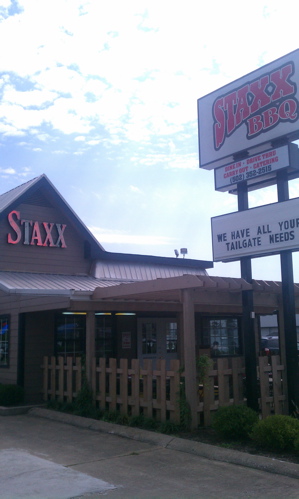
Staxx BBQ smokes up Kentucky’s state capital

Staxx barbecue in Frankfort, KY

In a town filled to the brim with fast food and chain restaurants, finding an independent meal can be hard to come by, but the smoke rising behind Frankfort’s relatively new barbecue joint, Staxx, is luring in loads of hungry diners.

Today my mom and I were looking for a hearty meal on the go and decided to give Staxx a try. My mom already was a fan, as Staxx had kindly agreed to cater the Sumptuous Southern Supper in August, which she and her nearly 1,300 Brainy Bodacious Women organized to benefit the Franklin County Women’s Shelter – I was informed the food was wonderful.

We both ordered the pulled pork sandwich combos, with potato salad and a drink, which was under $7 each. The nice price, comfortable atmosphere and tasty eats made for a pleasant overall dining experience at Staxx.

The smoked pork comes served on a bun, with several sauces available for those who like their barbecue wet, including a vinegar-based Carolina one, and a basic sweet sauce that also comes in a spicy or hot version. I found mixing the spicy or hot with some of the sweet got me closer to the tangy flavor I like. The potato salad was excellent.

The pulled pork sandwich and potato salad combo

I would prefer a little more smoky flavor out of the pork, but that might be a concession from using a propane and wood combination instead of a hickory fired pit. Regardless, Staxx is a welcomed addition to Frankfort’s restaurant scene.

Where I find Staxx has potential staying power in such a fickle restaurant market is its overall package. The food is good, it’s comfortable inside, there’s some atmosphere, the service was prompt (which is a HUGE issue for lunch), portions were plentiful and prices reasonable.

The owners, Dan Liebman, a former reporter for The State Journal and editor of the Blood-Horse in Lexington, and Chef Tommy Walters, who founded Furlongs and Furlongs Catering, set Staxx up to feel like a local roadhouse, where everyone is welcomed.

Staxx is warm and inviting, with plenty of tables and outdoor covered seating. The place was nearly filled to capacity for a late lunch, with state workers, construction crews, police, students, and members of the National Guard. Upon entering there is considerable memorabilia to admire from the Frankfort-area high schools, K-State, local celebrities, along with horse industry items.

Opened in May 2011, the restaurant is named in honor of Stax Records, the famous Memphis, Tenn. label that brought about a signature Southern and Memphis soul sound in the 1960s, which can be heard at a reasonable volume playing throughout Staxx. The restaurant’s seating area reflects this theme, with numerous framed posters and albums from Stax artists.

Customers may dine-in, carryout, drive thru or order catering. Drop by soon to smell what all the fuss is about.

Staxx BBQ

11 Carson Place, Frankfort, KY

(502-352-2515)

Hours: Sunday through Thursday, 11:00 a.m. to 8:00 p.m., Friday and Saturday, 11:00 a.m. to 9:00 p.m.

Posted in Food, Reviews | Tagged , , , | Leave a comment

Foster The People Comes to New Orleans

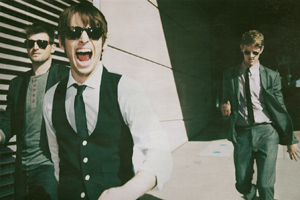
Hitting the streets with Foster The People, from left, bassist Cubby Fink, singer/guitarist Mark Foster and drummer Mark Pontius. Photo by Williams + Hirakawa

There might be a few people still out there that aren’t familiar with the smash single Pumped Up Kicks from Foster The People, but that number is dwindling quickly. And local fans can catch the band at the House of Blues tonight.

After topping the alternative radio chart for seven weeks, Pumped Up Kicks is being hailed as the summer jam of 2011. Rising to No. 3 on Billboard‘s Hot 100, the song has been certified platinum, moving over 1 million units thus far.

“We’ve been able to connect with kids on so many levels through this song, and it’s not just kids, but 80 year olds too – it’s great to see it start to happen,” said Mark Pontius, drummer for Foster The People. “It goes to what our band name is all about.”

The funny thing is this isn’t a new song. It came out in 2010, well before the band’s Top 10 debut album, Torches, was released in May 2011.

Pumped Up Kicks was written and recorded by singer/guitarist Mark Foster, originally as a demo in 2009, about two months after the band came together in Los Angeles. Foster, who has a background in classical music, had been doing freelance composing for television and film and was working on an acoustic-based side project before he began messing around with electronic orchestrations.

He played the song for fellow bandmates Pontius, and bassist Cubbie Fink. They liked the sound and about a week later, they posted Pumped Up Kicks on the Internet as a free download, and it has since taken on a life of its own.

It’s not just a catchy tune. A combination of effects has allowed Pumped Up Kicks to hit for the unlikely trifecta of Internet sensation, sleeper hit and crossover smash.

Foster the People isn’t necessarily an original endeavor. The band mashes-up assimilated genres and has a European flavor. Most of its songs have a noticeable ambient interlude with elements of trance and house present. This comes from Foster’s appreciation of British alt-rockers Blur and contemporary electronic composer Aphex Twin.

This alt-pop shoegazing is mixed with a healthy dose of 80s-influenced styling and low-fi vibe, a la MGMT, with a sprinkle of California dreams for good measure.

“The sound is what’s big in L.A. – we have that sunshine sound,” said Pontius. “Living by the beach, the sun and surf are huge influences on us.”

The laid back sound combined with the upbeat electronics and bass-heavy beats gives Pumped Up Kicks a modern edge. Add the catchy chorus and these elements coalesced into a monster success.

The beginning lead-in is longer than on most hit singles, and listeners are lured by the breezy, fun melody on the surface, while lyrically the song is about the threat violence.

Pumped Up Kicks takes us into the troubled head of Robert, a disillusioned youth, whose been bullied and neglected. One day he finds his father’s handgun in the closet and decides he’ll take it to school and exact some revenge upon his tormentors.

Photo by Aaron Redialed

Some listeners may never get what the song is about – they simply get carried away on the ethereal refrain, until noticing gun and bullets at some point.

He’s a cowboy kid – Yeah, he found a six-shooter gun; In his dad’s closet hidden in a box of fun things; I don’t even know what – But he’s coming for you, yeah, he’s coming for you


All the other kids with the pumped up kicks; You’d better run, better run, outrun my gun; All the other kids with the pumped up kicks; You’d better run, better run, faster than my bullet ~ sings Foster, on Pumped Up Kicks.

Foster composed the music first and then the lyrics, which explains some of the differences between tone and substance, but the dichotomy wasn’t unintentional. He wrote the song to raise awareness about gun violence in youth culture, particularly bullying and school shootings. Foster created the character Robert to go inside the mind of a child suffering from alienation and abuse. In many ways the song takes on a child-like innocence, with the looming violence disguised by the sugary sweetness on the top.

Regardless, the result has spawned a host of remixes and cover versions (check out Weezer’s version from their current tour).

On last check the YouTube video for Pumped Up Kicks had over 21 million views, and that’s just one version of the song. There are live takes, Internet-manipulated monkeys shooting guns and a version with the lyrics that’s racked up 5 million hits alone.

“We were a little concerned at first that something heavy might happen, but it’s been beautiful how the song has hit this chord all over the world and given a voice to this problem,” says Pontius.

The level of Internet buzz brought Foster The People to their debut show last year at South by Southwest (SXSW). Then they played Coachella without even having an album out. Their current tour has seen stops at Lollapalooza and Austin City Limits, and includes a string of mostly sold out shows for the 50 dates.

With the disc Torches selling consistently, and a second hit single, Helena Beat, climbing the charts, Foster The People is not a one hit wonder.

All the members are in their mid-twenties and enjoying the success, so look for earnest enthusiasm in concert. Foster The People adds two members when touring, and stretch the songs out, playing them in different styles to accentuate the material’s versatility. Expect heavy percussion to push their danceable pop live.

“We’re looking forward to New Orleans – we’ll have our pants down trying to get the crowd into it all,” says Pontius.

Foster The People | House of Blues | September 19, 2011.

#     #     #

Published by:  Gambit New Orleans | 09-19-11

Posted in Music, Reviews, Travel | Tagged , , , , , , | Leave a comment

A September To Remember

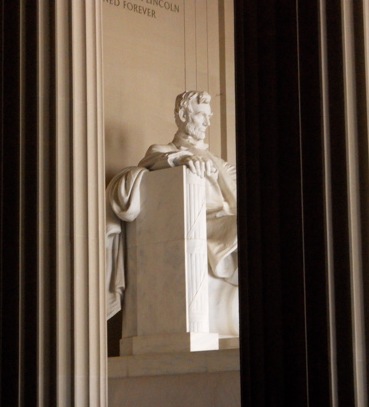
Mr. Lincoln stands watch.

On this 10th anniversary of the 9/11 attacks I’ve been moved unlike in previous years to take a conscious look back at that dire morning and reflect upon how America has changed since. Partly this is due to 10 years being a sufficient yard mark or measure, where an evaluation can be made. It also comes amid some of the greatest political rancor our country has ever witnessed.

The raising of the debt ceiling, Obama’s health care and jobs proposals and the slate of 2012 Republican presidential candidates have all brought forth seething political debate that borders on malicious intent. With this backdrop it seems appropriate to recall what happened, why and examine where America is now.

There’s a darkness that accompanies unexpected misfortune. Whether it be a deadly natural disaster, heart attack, car accident, drowning, school shooting, anything sudden or unexpected.

It forces a person to question WHY? Why that individual, why now, could it have been prevented – what should I do next? It changes everyone involved in some way. It makes you realize you’re vulnerable.

I was a resident of Washington, DC in 2001, having moved there after graduating college in 1991. Over the 10 years between my arrival and 9/11, Washington mainly just speeded up. President Clinton’s confidence in 20-somethings saw young people flock to the area to exercise their political action and ride the Internet boom in Northern Virginia’s tech-corridor. Cell phones, computers and Internet spread like wildfire, kicking the political game and lobbying into 24/7 hyper-drive.

Along the way there were hints of the growing anger towards our government. The truck bomb, in February 1993, that detonated below the North Tower of the World Trade Center, and the Oklahoma City bombing, in April 1995, should have dialed us in more as a country to domestic and international security concerns, but America has an arrogance about it – nobody wanted to believe we could be hit.

In the early morning hours of September 11, 2001, I was still out from the evening before. I had met up with a college friend, Terry, who was visiting from Kentucky to attend a business conference.

We got cocktails at the rooftop bar of the Hotel Washington, which offers spectacular views of the White House and National Mall. Then went for dinner around the corner at the Old Ebbitt Grill (http://www.ebbitt.com), situated across from the U.S. Treasury.

By the time our dinner was over it was 11:00 p.m., or thereafter, and we had consumed enough liquor to tranquilize an elephant. We needed to walk our intoxication down a notch, so we elected to hit the monuments at midnight.

We walked down to the Mall and took a right, on the dark, tree-lined path leading to the Lincoln Memorial. Homeless people could clearly be heard rustling around in the bushes – giving Terry some consternation about my enthusiasm for taking the path less traveled.

It ended up being perfect. For a while there’s only darkness and the sound of our breathing, then the glow of the white marble appears. The payoff instantly removes all thoughts of bodily harm.

Nearly 100 feet tall, it really is hypnotizing at night. Coming up the steps, shades of Mr. Lincoln become visible in between the columns. The view from the steps looking back across the reflecting pool, towards the Washington Monument and Capitol isn’t bad either.

It was past 1:00 a.m. by the time we walked down to Constitution Avenue, and after waiting a while Terry found a cab back to his hotel.

I decided to walk home. It was a beautiful night and the path up the National Mall and around the Capitol is one I often take. It’s peaceful to march past the Smithsonian and all the Congressional buildings bathed in moonlight – soothing somehow.

I vividly recall how I reassured Terry as we walked up the darkened path before reaching the Lincoln Memorial, how he would never forget seeing this monument. Little did I know this would be my last time seeing Washington in the same light again.

SEPTEMBER 11, 2001

I reached my Capitol Hill apartment around 3:00 a.m. I needed to be at work early, so I closed my eyes for a few hours, jumped out of bed, showered, hit the Metro by 7:15 and was in my office by 8:00.

I worked as a paralegal at a law firm off K Street, NW, a part of town that is home to Washington’s special interest industry. My firm specialized in insurance defense, or limiting the exposure of large insurers to pay claims when something nasty has transpired. I’m in early because I had some enormous document production to review.

I grabbed a cup of coffee, plugged in my headphones and cranked up Morning Edition on NPR, then started reviewing documents. By the time I settled in it was 8:20 or so.

I usually leave CNN’s Web site up all day. Slightly before 9:00 a.m., the ripple of something having struck one of the World Trade Center towers had begun making its presence known.

It took a minute to figure out the magnitude of what was happening. At 8:46 a.m., American Airlines Flight 11 crashed into the North Tower of the World Trade Center. It could have been an accident, but it didn’t feel that way. Then 17 minutes later, at 9:03 a.m., United Airlines Flight 175 impacted the South Tower, leaving no doubt the country was under attack.

Steadily office staff began migrating to the larger conference room, where people could be together watching this uncertainty unfold. Reports were circulating that planes were heading to Washington. Prior to 10:00 a.m., it was impossible to know the full extent of these attacks, or what was to come. Air traffic hadn’t fully been grounded yet.

There wasn’t anywhere safe to go. Considering the layout of DC, every block contained legitimate targets; the Capitol, the White House, congressional buildings, cabinet-level agencies, the FBI, numerous memorials, Embassy Row, just to name a few. It’s a target-rich environment, and my way home goes past most of these buildings.

At 9:37 a.m., American Airlines Flight 77 struck the Pentagon. Fifty-one minutes after the first plane hit the twin towers, DC was officially under attack.

At least one more plane was out there and widely considered to be heading for Washington. The government scrambled fighter jets to shoot down commercial airliners not heeding the emergency landing order.

I went outside with a buddy of mine, Pete, to get a sense of what was happening. It was the strangest sensation. Traffic was all over the place. People were scrambling in the streets to find ways out of the city. Smoke from the Pentagon fire was visible on the horizon and fighter jets were screaming across the sky.

We sat down on the curb outside of our building and took in the scene for several minutes – a definite “smoke ‘em if you got em” moment.

Once back inside it was reported that United Flight 93 had crashed near Shanksville, PA, at 10:03. All aboard were killed.

City and government officials had been requesting people stay indoors until the full extent of these attacks was ascertained. Sometime after 11:00 a.m., it seemed reasonably safe to venture back outside.

I wanted to find my wife. Reports were the State Department was an intended target. She was teaching classes at George Washington University that morning, which is located three blocks from the State Department.

I tried calling, but it was hard to get any calls through and she turned her phone off during class anyway. I asked Pete to go with me, which he kindly agreed. We were only four blocks from GW, but as soon as you walk away from the television, there’s no knowing what might be happening.

We finally reached her. Evidently GW’s emergency plan needed some work yet, as a few classes remained in session and unaware of the day’s events. We got out of there fast and headed back to the law firm. It still seemed like the safest place.

We ended up staying there into the afternoon. At some point one of the senior partners sent around a ridiculous e-mail about how we should focus our attention upon serving our clients. And lawyers wonder why they get such a bad rap…

This workday was done before it started.

Metro was running cars to get commuters out for a while, but they were packed, and I had no interest in riding on an underground public transit system. We opted to take a long, contemplative walk home. The only thing buzzing in DC was helicopters and law enforcement. I don’t remember much from this walk accept the militarization of the city. Cops of all varieties were everywhere.

At home we flipped on the television like everyone else. My wife and I laid in each other’s arms, our eyes red from tears shed at the sad images on ABC News.

I continue to be thankful for Peter Jennings working so hard that day. He stayed on air for something like 17 straight hours, consoling viewers and making sense out of what had happened. I was up till after 3:00 a.m., watching coverage until I was confident nothing new was being announced. Then I put September 11th to bed.

The four coordinated suicide attacks claimed the lives of 2,977 people.

AFTERMATH

I think back on that day often. It’s one of those seminal moments, where the dichotomy between before and after is perfectly crystallized. America was simultaneously altered forever.

Now on this 10th anniversary I remain curious as to whether as a country we have actually dealt with 9/11. Yes everyone witnessed what happened that day, but to understand the significance of those acts and why they happened isn’t always as easily explained or embraced.

We cleared the debris, built memorials and proudly wave flags at pro-football games, but that doesn’t get at why 19 men were willing to go to such lengths and trade their lives in order to attack America.

The U.S. has meddled in Middle Eastern politics for years, mainly due to our country’s unquenchable thirst for oil, and in general, we’ve blatantly disrespected that region’s customs and social norms.

I don’t condone terrorism or any of what these conspirators carried out. But we’re taking the easy road by simply painting al-Qaeda and Osama bin Laden as evil men who hate America. There are reasons for their hate. If all we do as a country is put more security in place, instead of addressing the underlying causes for this anger, we invite further violence.

It’s also important to recognize that tragedies such as the ones on 9/11 aren’t the only way for terrorists to claim victory. By forcing the United States to clamp down as it has with security measures nationwide, certain freedoms and privacy rights are tested. The government ends up being pressured into creating a fear factor with its efforts to prevent future attacks.

As awful as 9/11 was, the physical violence was isolated to New York City, Washington and a rural field in Pennsylvania, while the aftereffects continue to ripple across all of America. In 2004, I moved away from Washington for several reasons, but the post-9/11 metamorphosis of DC into a militarized zone was a significant reason why.

Washington has a completely different feel to it these days; snipers are a permanent visual fixture atop the White House, dozens of law enforcement agencies, in addition to armed building security, now blanket downtown Washington and Capitol Hill, elevated terror threat levels force road and school closures, airports are a nightmare and surveillance cameras are everywhere.

Visitors might not notice, but living around this heightened level of security day-to-day adds a layer of pressure to ordinary life – especially for those who lived in DC prior to 9/11 and are aware of the difference between before and after.

It’s something residents get desensitized to, and that’s not a positive. Slow erosion of our freedoms could very well result in one day waking up to find “certain unalienable rights” have been revoked.

Besides this allows terrorism to win. It breeds paranoia into the populace.

A healthy home security is paramount, but it can be balanced. We can stay true to our country’s ideals, protect our people and not participate in jingoism.

Ultimately Hurricane Katrina took down the Bush administration, but the partisanship and flag waving used as sleight of hand during Bush’s years in office, to take the public’s eye off the illusion that Iraq was a justifiable shoot, have since escalated to the point that nothing can get accomplished in Washington. It’s all who can win and obstruct the other side, regardless of whether America ultimately suffers.

I just don’t want to look back and see we squandered an opportunity. The September 11th attacks wiped the slate clean of partisan bickering and offered a unique moment for citizens and politicians of both parties to join together and work as one on what was right for America. Unfortunately that moment passed quickly.

This country has a series of amazingly difficult dilemmas facing it, none with an easy answer, and no amount of flag waving, declarations of “America being No. 1” or tax cuts is going to solve any them.

Unless we as a people can come together and work with the government to address issues like the nation’s crumbling infrastructure, jobs, housing prices, insufficient retirement incomes, alternate energy sources, health care, Medicare, Medicaid and Social Security, chances are both parties will continue playing their high-stakes game of musical chairs – pushing these issues further down the line until the music stops and no chair is left.

It’s time for America to get back to work, and stop resting on past achievements. The country and its citizens are suffering. Everyone in this country needs to step up and accept responsibility for getting America back to solvency.

Our eyes were opened and our skin stung by the hand of terrorism on September 11th. Subsequently the wear and tear from our way of life has begun to show through as another vulnerability. We can fix what ails America, but do we have the willpower.

I can’t thank our first responders enough for their heroic duty on September 11, 2001, and will never forget the sacrifices they made or the ones felt by their family members left behind. Nor shall this country forget any of those who perished on that fateful day.

It is to them that we owe a debt, which can be repaid by making certain our shores are secure, while at the same time accepting the challenge to responsibly address what plagues this great nation and ensure America remains a society where “life, liberty and the pursuit of happiness” is available to all.

Posted in Events, News | Tagged , , , , , | Leave a comment

Return to the Bluegrass

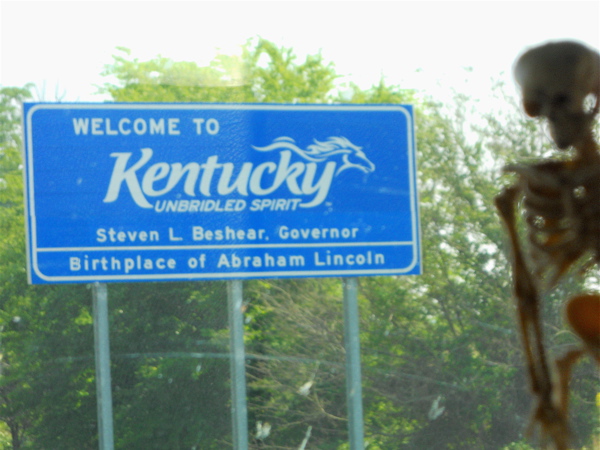
Crossing the Kentucky border as I traveled north from New Orleans. It's good to be home!

The Llama has left the building. Yes after some wanton recklessness, questionable decision making and ongoing personal issues, the Llama has moved his bag of tricks from New Orleans home to Kentucky. Not sure of my plans yet or the duration of my stay, but nice to be around family, friends and familiar pets at this time. Life is an adventure, and as the Grateful Dead alluded, “It’s a long strange trip.”

Since Hurricane Katrina, in 2005, life has been in constant flux, especially the time between finishing grad school at the University of Iowa in 2009, returning to New Orleans and now departing the Crescent City once again – just one lengthy blur of motion. That being said, while I feel I’ve taken a few body shots, I continue to look at life as a series of opportunities, with each day offering a new set of rabbit holes waiting to be explored. As fellow Kentuckian, Hunter S. Thompson said, “Buy the ticket take the ride.”

I’m not sure where I’ll land next, all I can say is Kentucky is a good fit for me right now. After some healing and getting my legs steady I’ll be ready for the adventure to continue. For the time being I’m going to play catch-up. Look for a run of tidbits from my last few months in and around New Orleans. Going forward, I’m excited at the prospect of exploring all the dives, music, food and characters the Bluegrass has to offer.

Posted in News, Travel | Tagged , | Leave a comment

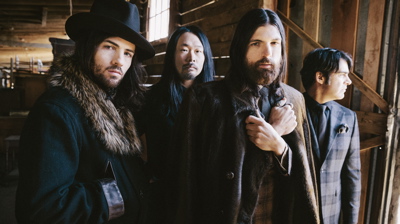
Out of Carolina: The Avett Brothers’ Path to Success

The-Avett-Brothers

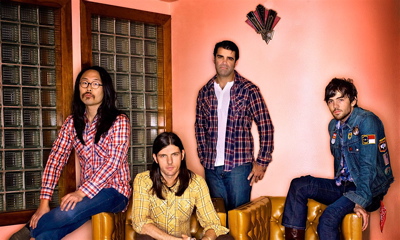
From left: Joe Kwon, Seth Avett, Bob Crawford and Scott Avett of the Avett Brothers.

Like many young aspiring musicians, Seth and Scott Avett’s early visions of rock music stardom were anything but simple. But putting aside the wreckage of a rock band and keeping things simple put them on a slow and steady path to creating the genre-bending trio the Avett Brothers. The band mixes bluegrass, folk and punk rock to create a unique brand of Americana-roots music. Several years of hard touring have helped earn the band a devoted following but the brothers remain largely unfazed by their success, keeping their humble North Carolina upbringing close at heart.

“It was a total lack of planning that got us our sound,” Seth Avett says. “We took all of Carolina’s culture – the education, universities, people, music and sports – and added it into the stew, it wasn’t intentional, but our sound came out of all that.”

The band began taking its current form 11 years ago in Charlotte. Scott Avett, 34, and Seth, 30, had been in bands during high school and college, and at the time were fronting a neo-punk outfit known as Nemo. It satisfied their lust for electric guitars and the brothers shared a rebellious urge to create something distinct and grand enough to stand out from the shadows of NASCAR and big-time college basketball. As they envisioned it, Nemo was supposed to be the band that got them on the cover of Rolling Stone.
At the same time, the brothers also experimented with acoustic instruments and the traditional sounds they grew up around. This resulted in forming what came to be known as The Back Porch Project – or Nemo Downstairs. The side band featured Scott on banjo, Seth on acoustic guitar, and Bob Crawford soon joined the brothers on upright bass.

When Nemo fell apart there was a mourning period, like the demise of that first great high school romance. “It was very difficult, and a hard breakup,” Avett added, about Nemo disbanding. It maybe wasn’t the same depth of love you share with your wife, but this was our first love, and it was genuine and intense.”

Nemo was supposed to be the band that got the Avetts on the cover of Rolling Stone. When that didn’t happen the brothers were hesitant to attempt starting up another five-piece. Instead they turned to The Back Porch Project, and began focusing more intently on pushing past traditional acoustic formats typically heard in country, bluegrass and folk music.

When Nemo fell apart it hit the brothers hard, like  the demise of a first great high school romance.

“It was very difficult, and a hard breakup.” Seth says. “It maybe wast the same depth of love you share with your wife, but this was our first love, and it was genuine and intense.”

The brothers were hesitant to attempt starting up another five-piece rock outfit. Instead they turned to the Back Porch Project and focused on pushing past the traditional acoustic formats of country, bluegrass and folk music.

avettOut of Nemo’s debris the Avett Brothers emerged. It featured a leaner lineup, and it was mobile due to the acoustic instruments – they could play anywhere.

“We took the ambition out of it when Nemo folded, and stopped thinking about being on Rolling Stone,” Seth says. “We wanted a band where I could simply count on Scott, and Scott could count on me.”

The Avett Brothers released a self-titled EP in 2000. By 2002, the current lineup was in place and the band issued Country Was. Even after that release and a brief tour, there were discussions between the Avetts about graduate school and pursuing other careers. But the band played on and released A Carolina Jubilee in 2003.

It gained the band some traction by harnessing the intensity of its live shows in a studio release, and it further refined the band’s signature sound. The Avett’s wanted to take this band to new heights by keeping it simple. As the band took off, they resisted moving to New York, Los Angeles or Nashville, instead continuing to make Concord, N.C., home.

The brothers were raised on their family farm in Concord, about 30 miles north of Charlotte. Their father, Jim Avett, was a welder by trade and an accomplished musician in his own right, (he has released two albums of country songs since 2008). Growing up around the farm, not only were the brothers exposed to hard work, they also were able to explore their father’s musical influences.

Scott and Seth sifted through recordings by Bob Dylan, Doc Watson, Woody Guthrie and Ramblin’ Jack Elliott, among others, studying the way these artists played, sang and told stories. In turn these historic influences were mixed with harder edged artists popular at the time.

Conspicuously absent in the Avetts’ background is bluegrass. It’s tempting to place a bluegrass label on the band when one sees the banjo, but the Avett Brothers defy the genre. It’s less Bill Monroe and more AC/DC’s Angus Young, only with a banjo.

The sound has been referred to as “grungegrass,” “grungefolk” and “punkgrass.” The Avetts seek to create music similar to what they heard growing up, so their songs are built around traditional structures, but the Avetts’ other musical influences, attitude and ferocity take the instrumentation and sound to a different place. Tempering the more rambunctious elements in the Avetts’ music are the lush harmonies created by Scott and Seth, and played out in three part harmonies live.

avettbros_bydannyclinch_wide-22c1b4f01eb1fccc24c58ded5f889267ad2c88dcBand members often sport a look that suits the amalgamation of grunge, folk, punk, country and bluegrass. Call it a circa-Civil War appeal, with tight dress jackets, suspenders, and varying levels of scruffy facial hair in disarray, reminiscent of grainy black and white images of rebel soldiers. But it’s also similar to the look Robbie Robertson and Levon Helm cultivated with The Band in the late 1960s.

At other times, they revert to unassuming thrift-store slacks, plain white T-shirts and bandanas hanging out their back pockets.

Regardless of appearance or sound, songwriting is the core element responsible for the Avett Brothers’ success. Playing music might be considered Scott and Seth’s profession, but songwriting is their craft.

“I started writing when I was 13 or 14, and it set me on fire,” Seth says. “I was drawn to it and knew it would be a lifelong pursuit. It’s a blue collar effort, like laying brick, to get half decent at it you have to put in the time.”

Their lyrics conjure strong visual imagery, and they are influenced by their grandfather Clegg Avett, who was a Methodist minister, and the likes of Kris Kristofferson, Hank Williams and especially Tom T. Hall.

The brothers’ songs capture raw emotion, spirituality and self-effacing moments of evolving maturity. The lyrics are almost conversational, like a back and forth one of the brothers is having in his head, only shared openly such as in The Ballad of Love and Hate, where Seth sings:

Love writes a letter and sends it to hate; My vacation’s ending, I’m coming home late; The weather was fine and the ocean was great; And I can’t wait to see you again;

Hate reads the letter and throws it away; No one here cares if you go or you stay; I barely even noticed that you were away; I’ll see you or I won’t, whatever.”

His voice is gentle but forceful, with delicate phrasing that lightly veils the angry undertones – lifted when the song is played live and seething with energy.

High and lonesome harmonies are mixed with a strong narrative that appeals to audiences.

“I haven’t met anyone that doesn’t have demons, and it’s therapeutic to say and get some of mine out in my writing,” Seth says. “At first it’s for me, five years later it becomes for the audience.”

Up until 2008, the Avett Brothers’ music was produced by manager Dolph Ramseur, via his label Rammer Records. Then producer Rick Rubin came calling. Rubin has worked with musical renegades including Johnny Cash, the Dixie Chicks, Rage Against the Machine, the Beastie Boys and the Red Hot Chili Peppers. The Avett Brothers signed on to Rubin’s American Recordings label, and he produced the 2009 album, I and Love and You.

Bucking trends is nothing new to the brothers, and they joined a major label at a time when bands like Radiohead and Nine Inch Nails were choosing to produce their own albums.

“It was time, and I wanted them to have every tool in their belt to play with for this last recording,” Ramseur says. “We just didn’t have enough money to be in the studio too long, and we’d have to play fast to get out.”

The songs on I and Love and You are the best example to date of the energy found in the band’s live performances, but refined with the technical crafting that comes with a bigger budget. Typical of a Rubin recording, the extras are stripped away, leaving the band’s emotional sentiment and playing.

2012-10-02-AvettBrothersWhile more of a balloon ride than a blastoff, the Avett Brothers’ success increased demonstrably since signing with Rubin. Having already released 10 albums, they had attracted a loyal following, particularly in the Carolinas, but with I and Love and You peaking at No. 16 on the Billboard 200, the Avett Brothers began opening shows for The Dave Matthews Band and Widespread Panic. Rolling Stone added the band to its “Artists to Watch” list in 2009.

The Avetts plan to record with Rubin again, but they’re hitting the road for summer tour dates first, adding touring members Joe Kwon on cello and Jacob Edwards handling percussion. Scott and Seth are primarily known for playing banjo and acoustic guitar, but they change instruments during live shows. The manic playing brings more energy, screams from alternating band members and popped strings, yet nobody misses a beat.

“A live setting offers a spontaneity, excitement and power that a studio will not provide,” Seth says. “Every day the live energy that comes from an audience changes, and we feed off it.”

#     #     #

Published by:  Gambit New Orleans | Vol. 32, No. 17, p. 31 | 04-26-11

Posted in Liquor, Music, Reviews, Travel | Tagged , , , , , , , , , , | Leave a comment

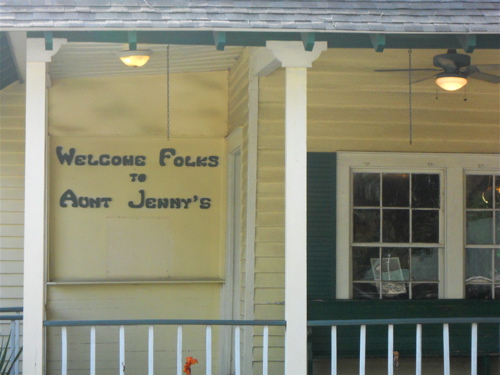
Aunt Jenny’s Catfish Restaurant

Aunt Jenny’s serves up “all you can eat” catfish, shrimp and fried chicken.

I was looking for a detour on my way back from another trip across the Gulf Coast. Leaving from Gulf Shores, Ala., I wanted to find a restaurant that served something other than barbecue and was at least halfway back to New Orleans.

This is a 3 hour drive. Half way puts me in no man’s land, but Ocean Springs, Miss., is 2 hours away.

The historic, tree-lined downtown boasts a strong arts community and offers a number of independent local restaurants that take advantage of the proximity to fresh seafood.

Aunt Jenny’s Catfish Restaurant is known for its never-ending fried seafood and chicken, but what piqued my curiosity was its notoriety as a place Elvis Presley was known to frequent. He regularly occupied a back booth in the restaurant’s Julep Lounge.

Located inside an old house dating to 1852, the parking lot sports several 500-year old oak trees. The restaurant sits at the mouth of the Bay of Biloxi, where the back dining room allows expansive views of the water in three directions.

It’s a lovely atmosphere, and feels removed from downtown and the nearby interstate. It’s the kind of place where time slows down. Do take into account this is an old-fashioned establishment and looks the part. It may take a minute for the staff to get around to all the tables, but they’ll get there. This is part of Aunt Jenny’s charm. Have a cocktail and relax.

The menu is a brief read, two narrow pages that presents essentially three menu items: catfish, shrimp or fried chicken.

This is a tremendous bargain regardless, but if you show up at Aunt Jenny’s hungry this is nirvana.

The catfish and shrimp come in large orders, but for a buck or two more, super-size it to “all you can eat.” If choosing between these two items proves too difficult go with Gunny’s Combination, which provides all the catfish and shrimp a person can eat for under $15.

I was in a tough spot, because I normally would order the catfish. Quality fried shrimp isn’t difficult to find across the Gulf Coast, I could forgo that. But catfish done right is sublime.

The problem was I love me some fried chicken. Ronnie’s Roosters only come in “all you can eat” proportions. The mixed is $9.95, and Namaw’s white meat special is a dollar more.

For a moment I actually considered ordering the catfish and the fried chicken. But how would I be able to walk out of the restaurant?

Besides, all these menu items come with “trimmin’s.” You gotta love trimmin’s!

This consists of: country seasoned hush puppies, potatoes, crispy vegetable sticks, cole slaw and fresh-baked homemade biscuits with jelly.

Now we’re talking southern.

There appears to be some debate over the spiciness of the hush puppies. They have a thick cornmeal crust, that ensures the interior remains moist, with Jalapeno pepper bits mixed in with the batter, which some complain make them too spicy. I found the dense outside coating tempers the spicier middle. Unless from the Midwest, I wouldn’t consider these hush puppies especially “hot,” but be warned if your taste buds are sensitive.

The biscuits are a nice size, airy and rich. I could have filled up on them alone. I had to forcibly stop myself from ingesting anymore before my entrée arrived.

One appetizer or side item deserving notice is Kathy’s batter fried dills. Fried pickles are something you can’t find everywhere. At Aunt Jenny’s they batter-fry entire dill spears, which is even more unique, and worth checking out.

As for the main items, I went with the all white meat fried chicken and it was fabulous. The skin was crisp, and a dark rusty golden brown, that crunched as I bit into it. The inside jumped with flavor, and was tender and moist. Loved it!

Personally I didn’t see much difference between a large order of catfish and “all you can eat.” One plate is gonna get it done for most people. There’s four or five fillets in a large serving. Admittedly these are local, pond-raised catfish, that are smaller and thinner than the hefty, farm-raised version found in most supermarkets, but a considerable serving regardless.

The batter is a simple flour and cornmeal mixture, not too heavy and doesn’t overtake the silky catfish flavor. I enjoy the milder taste of these smaller, pond-raised fillets.

I can’t vouch for the shrimp. I heard different stories, some saying they were small-ish. I wouldn’t expect the typical large, prawn-sized Gulf shrimp, not at this price for “all you can eat.” There are better places to get shrimp so consider that, but it’s hard to go wrong with the catfish and shrimp combo. What’s the worst that happens — you order another plate.

This is a quaint and comfortable place to dine, but not upscale. Aunt Jenny’s is homey, and on a busy night the service for “all you can eat” is going to suffer. This is table service – not buffet. Good fried chicken is never fast, so choose the times you go here carefully. If you’re in a rush you might be disappointed. I went for a late lunch and had no problems.

In the end, Aunt Jenny’s is about totality. The food is good, but factor in the location, the historic property, the trees, the view – come kick back, fill up on southern hospitality and have a drink where Elvis used to hang.

1217 Washington Avenue, Ocean Springs, MS

228-875-9201

www.coastseafood.com/jennys.html

Posted in Food, Reviews, Travel | Tagged , , | Leave a comment

The Brick Pit

Coming through Mobile, Alabama, I knew there was some excellent BBQ to be had, but hadn’t found the right spot. Dreamland (www.dreamlandbbq.com), based out of Tuscaloosa, Ala., and The Shed (theshedbbq.com), from Ocean Springs, Miss., both have a presence in Mobile and are excellent, but I was seeking something independently local.

After some research, The Brick Pit (brickpit.com) jumped out from its competitors as a bona fide “barbecue joint.” Considering it’s a relatively small establishment, it has racked up some big time accolades.

The Travel Channel named it one of  “America’s 101 Tastiest Places to Chow Down,” it won 1st place in the rib competition on the Food Network’s “All American Tailgait Cookoff,” and The Brick Pit was chosen as one of the five best BBQ restaurants in the South by the Atlanta Journal-Constitution.

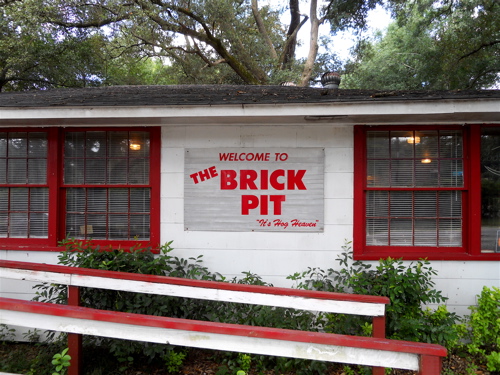
Outside the main entrance of The Brick Pit.

The restaurant is operated inside an old house and sits back off the road a piece. Parking is available out front and around back, where trees shade the whole area – a welcomed benefit on a hot sunny southern day.

As I pulled in two men were tending a large black smoker along the side of the restaurant, and I could taste the smoky essence of the infused wood and pork.

This setting is all a BBQ connoisseur could imagine: a hole in the wall establishment, smokers going out back and three menu items only: pulled pork, ribs or chicken.

The Owner, Bill Armbrecht, and pitmaster Jerry Edwards have a shared philosophy, to do everything slowly, just as it should be. And that simple sentiment is what sets apart the barbecue at The Brick Pit.

This old house doesn’t have an oven, so all the cooking gets done in the pit. Armbrecht built a large, red, room-sized smoker out back amongst the trees, known affectionately as “Big Red.” Never forget we are DEEP in Alabama football country, where everything is better red. Roll Tide! (My apologies to the current college football champions at Auburn – War Eagle!)

The Brick Pit smokes with a wood mixture, 75 percent pecan and 25 percent hickory, and the ribs don’t get spiced before they go on the pit – the smoke does all the flavoring.

Evidence of the good-natured rivalry between The Brick Pit and its more corporate expansive BBQ brethren from outside Mobile, perched noticeably on the ramp leading up to the main entrance.

Then it cooks low and slow. That’s low temperature for as long as possible.  The pork shoulder is in there for 30 hours, the ribs go for 12 and the chicken is smoked 6 to 8 hours. The fat in the meat serves as a natural moisturizing element during this long cooking process.

Not many places take the time to cook ribs this long. As a result, the pork is tantalizingly tender. It melts in your mouth. The rib meat can be plucked off the bone with a finger’s touch and the hand-pulled pork is juicy and thick, interspersed with crunchy charred bits from the crust of the pork shoulder.

Coating the pork and chicken is a thick, tomato-based sauce, not too spicy, but adds a tangy flavor that brings out the smoky essence in the meat. The sauce is also cooked up inside the pit, as are the baked beans.

Bring along a Sharpie to The Brick Pit and add to the ambiance.

Everything is made from scratch at The Brick Pit. Mrs. Iona Waits comes in daily to make her decadent homemade banana pudding. It comes served in a styrofoam bowl, no frills, just like The Brick Pit, and has a devoted following of its own.

Orders are taken from a window in the back of the dining room. There’s sufficient seating for dine-in, but it’s evident by the number of folks waiting on pick-up orders that The Brick Pit does a robust carry-out business.

Patrons and fans alike pay homage to this “House of Pig” by scribbling testaments, well wishes and salutations to The Brick Pit across its walls, doors and ceiling – mostly in red markers, creating a loud “Thank You” in Alabama parlance for all to see. It makes for interesting reading while waiting on my order.

As one sign reads, “Welcome to the Best Damn Smoked Bar-B-Que in the Great State of Alabama.” Who am I to argue with a man who smokes his pulled pork 30 hours.

5456 Old Shell Road (near University Boulevard), Mobile, AL

251-343-0001

www.brickpit.com

Posted in Food, Reviews, Travel | Tagged , , , , , , | Leave a comment

Gettin’ Fed at The Shed

I’ll admit from the get go that I am a “Ho” for barbecue. Whether I’m traveling for other purposes or just to obtain some of this mouth-watering smoky goodness, all it takes is a rumor of a decent barbecue joint and I’ll divert over 100 miles to snatch some up.

Whether it’s a shack by the side of the road, a smoker on wheels by the gas station or some displaced Texan offering BBQ brisket from the backroom of a bar – honestly the more ramshackle the joint, often the better the BBQ.

Since I was going to be traveling through southern Louisiana, Mississippi and Alabama anyway, it was a no brainer to poke around on the Internet and ask folks about good dive joints along the way.

I was planning to eat seafood and Cajun fare mostly, but as much as I adore both those styles of cuisine, I like to break up the flavors and give my palate a chance to recharge.

Cajun food is simple in concept, but complicated with its bouquet of flavors as all the ingredients cook up, while seafood is much more stripped down, with only light seasoning, butter and lemon added to accent the fresh catch.

So I’m putting BBQ in an unfamiliar spot, to serve as a cleansing meal between spicy Cajun dishes and the milder seafood. As you can tell I’m eating light and healthy — NOT!

In my constant search for quality dive establishments I came across The Shed in Ocean Springs, Miss. The place really is a shed. The story goes that owner, Brad Orrison, had an unusual hobby while attending college at the University of Mississippi – he collected trash. And I don’t mean like a garbage man. Brad was a first class dumpster diver.

The main entrance to The Shed in Ocean Springs, Miss. “Come get fed at The Shed.”

His favorite time of the week was the night before trash day, when the street side garbage piles were at their height and dumpsters were brimming full. Brad could be found combing through used two-by-fours, old tin roofing, bent nails, ugly windows, old plastic buckets and warped records – it was pure junk, but he refused to part with any of it.

After graduation, he constructed a trailer from his cache of debris, loaded the remaining refuge onboard and returned to Ocean Springs.

It was during a dumpster dive one evening, while knee-deep in warped hardwood flooring, that Orrison, 24, had an epiphany: that he should build his own BBQ joint.

With the help of his sister Brooke, 19, they hammered together the beginnings of The Shed. After practicing their smoking and timing techniques for the meats, and Brad got his secret Shed rub down to perfection, all they needed was a sauce.

In stepped Robert “Poppa Jack” Jackson, who had retired from the military, and relocated to the Mississippi Gulf Coast. Poppa Jack had been working on his BBQ sauce for over 20 years, testing it from Naples, Italy to Grand Forks, ND. He had considered marketing the sauce, and after a fortuitous crossing of paths between Brad Orrison’s aunt and Poppa Jack – that’s how The Shed found the man who makes the sauce.

As they say down in Ocean Springs: “Wham!!! Bam!! The RUB, the SAUCE, THE SHED!” It’s referred to as Poppa Jack’s Shed Spread.

He started out delivering only three gallons of sauce in mason jars, but prior to his passing in 2002, at the age of 51, Poppa Jack was crafting 50 gallon batches in his huge cooking pot, engraved with his name on it.

Prior to making his last batch he insisted Brad memorize the ingredients – wanting to eliminate the recipe on paper, that way only the two of them would know the secret. It took Brad 11 months to get the sauce just like Poppa Jack used to make, and nine years later the sauce and The Shed continue to grow in stature.

It can get rowdy in The Shed – do be kind to each other. Even rival SEC fans should be able to chill over good BBQ.

Yet the Shed is not just a BBQ joint. It’s a first class blues music venue as well. A couple of months after The Shed opened, Orrison’s brother, Brett, 22, came on board as the sound engineer and entertainment director. A stand alone stage was built outside the main venue, and long picnic-style benches and tables were erected to maximize seating and eating.

The BBQ is plenty good enough on its own, but the music makes The Shed into a gathering place. It reminds me some of Buddy Guy’s club in Chicago, Legends (http://buddyguys.com).

The Shed has this killer down home comfort food, sizzling blues music and room outside to dance around under the stars when the mood strikes – it’s dinner theater for those bent on relaxation.

Over the last nine years The Shed has spent $700,000 bringing the Blues to the coast (not including their annual blues festival), all free to the public. That’s what they’re doing to keep the Blues alive. Artists have included Buddy Guy, PineTop Perkins, Bob Stroger, Willy “Big Eyes” Smith, Walter “Wolfman” Washington and his Roadmasters, the North Mississippi AllStars and Kenny Wayne Shepherd.

The Shed began as a 300 square foot takeout stand, but after locals sampled the tangy BBQ, they wanted to help the Orrisons facilitate the crowds that began showing up. So as a takeoff on the Grateful Dead’s devoted fan base, known as “Dead Heads,” frequent flyers at The Shed are, you guessed it, “ShedHeds.”

Over the years, the ShedHeds have brought along their own collected waste and debris, and assisted with 39 expansions on the original carry-out window in Ocean Springs, morphing it into a 6,500 square foot screened-in back porch essentially.

Low light and debris for as wide as the eye can see inside the bar area and main dining room (if you can call it that).

Currently there are six Shed locations, all different, but the original, located 100 miles from New Orleans, and 20 minutes from Biloxi, remains unique. The place looks like it’s had 39 additions – it ebbs and flows, and continues moving along where you can tell it used to stop, nothing matches, the floors are warped, definitely watch your step going from one room to the next, there’s pig art all about, and most of the place is lit up with Christmas lights.

I wonder if the fire marshal has been by recently for an inspection.

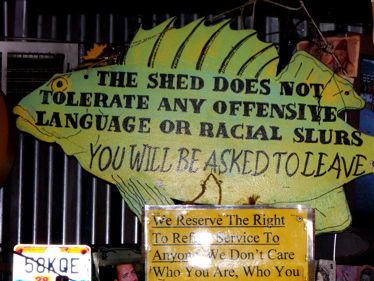
Careful what you learn at The Shed.

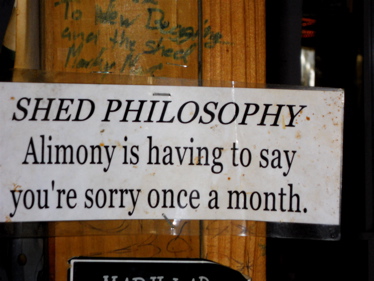
Filling in the open crevices tend to be dollar bills, license plates and cards or placards with bits of “The Shed’s Philosophy” written upon them. This atmosphere runs up every wall and across the ceilings. Even the wood tables, benches and post are not exempt. Customers have taken to writing or carving their own sayings or remembrances into the wood.

Orders can be placed at the carry-out window or at the bar. Then take a seat and wait for your name to be called. The rack of baby back ribs is majestic and tender, while the pulled pork is succulent, moist and full of flavor. Most anything on the menu will feed more than one person, especially with the sides, but I prefer “To-Go” portions, so there’s a snack for later.

The wings are decent, hearty, a tad too much on the BBQ side for me, but go great with a beer. There’s a television above the bar and this is an amusing place to try to watch a college football game – especially if it involves SEC teams.

The Shed was nominated for their pulled pork sandwich to vie for the Ultimate Hometown Grill Off Recipe on the Live! Regis and Kelly Show. The Orrisons flew up to New York, slow smoked the pork shoulder and came home with the trophy, along with a full spread in the March issue of Better Homes and Gardens.

Admittedly the pig emblem and some of the sayings do come across as slightly heavy on the marketing side, but the folks here believe in what they’re doing and have managed to prevent the expanded locations from being cookie-cutter reproductions. They smoke a ton of meat a day at the Ocean Springs location, every day, so drop by and help add to The Shed. Brad’s a little busy these days for dumpster diving.

Gratefully Fed

7501 Hwy 57, Exit 57 off I-10 (north 1,000 yards), Ocean Springs, MS 39565

228-875-9590

http://theshedbbq.com

Posted in Food, Reviews, Travel | Tagged , , , | 1 Comment

Mobile to Pensacola

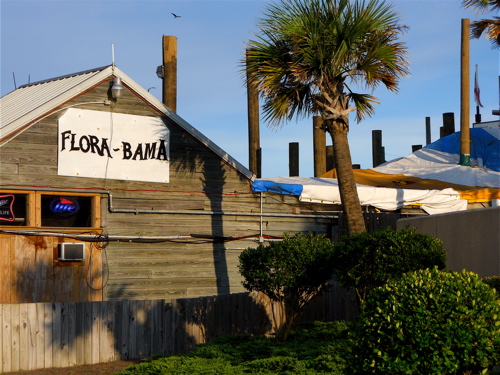
Sunset behind the Flora-Bama Lounge at Perdido Beach, Ala.

The reality television road was coming to a halt. Having finished interviewing Michael Breland, who ran two bail bonding shops in Mobile, Ala., I had found what I believed was the final candidate in a diverse group of bounty hunters that also included a former biker, a loose cannon and two lesbians, from which the network could choose to base its show around, entitled “I Am The Law.”

Now it was time to move past Mobile’s seedy underside, and take a moment to admire the city’s charm. I had a hotel reservation that night in Orange Beach, Ala., so I had a limited time to investigate Mobile, but wanted to hit one or two places to get a better feel for what went on in the city and how accessible it was to someone passing through.

Food and a beer would get this goal accomplished. Mobile sits on the water, so seafood was the natural choice. The central park area or Bienville Square is at the heart of the downtown area. The primary artery running past the park is Dauphin Street, which is filled with bars, live music clubs, restaurants and coffee shops.

Outside Wintzell’s at 605 Dauphin Street. Get those oysters – “fried, stewed or nude.”

I chose Wintzell’s Oyster House, partly because it appeared so inviting, with its large porch and easy parking. It also had a lively number of people inside for mid-afternoon, and laughter was spilling out onto the street.

Wintzell’s is located about half-way down Dauphin and perfect for those walking around downtown.

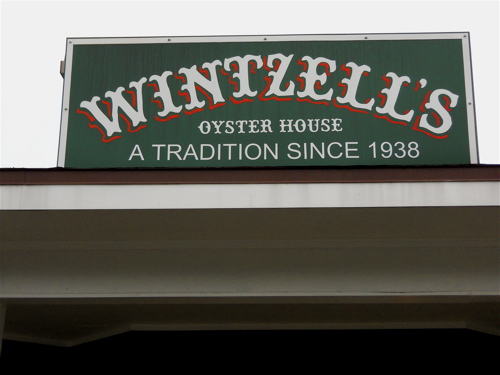
Named for its former owner, J. Oliver Wintzell, the restaurant opened in 1938 as a six stool oyster bar. Now its a modest chain with 12 locations along the Gulf Coast. Famous for its fresh Gulf seafood and oysters (served fried, stewed or nude).

The Dauphin Street location is the original. Inside are two main dining rooms, and a central bar holding residence for those wanting a quick fix of raw oysters.

The owner may be gone but his witty rhetoric remains.

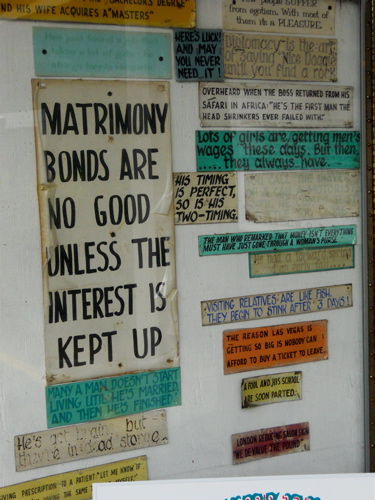
The interior has an eclectic flavor, littered with Alabama sports memorabilia, particularly Alabama football (Roll Tide!), but the predominant decoration is hundreds of different colored cards and plaques with homespun statements from Oliver Wintzell.

People who are too sharp cut their own fingers.”

“You can sometimes get a pearl from an OYSTER, but it takes a pretty girl to get a diamond out of an OLD CRAB.”

“If the knocking at the door is unusually long it isn’t opportunity knocking – it’s relatives.”

“If work is a virtue, many of us are living in sin.”

It was after 2:00 p.m., too early for happy hour, but the bartender, Jared, informed me the appetizers were half off this afternoon. I took a chilled mug of ale, an order of fried crawfish tails (can’t argue with half-price) and a half dozen oysters on the half shell. Being this far east was enough to allow oysters to be readily available and not overpriced due to the BP oil spill.

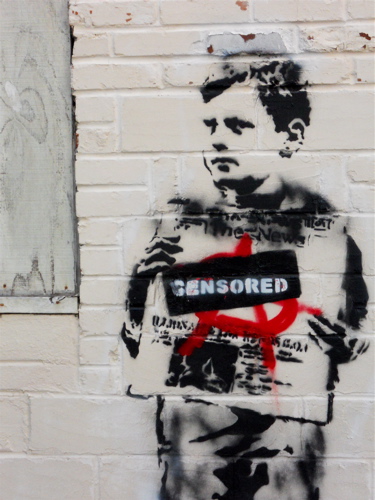
Graffiti across from The Garage in the style of legendary British street artist Banksy.

The oysters were plump and flavorful, and the crawfish had a light, spicy batter set off with a creamy remoulade dipping sauce. This was just the hearty lunch I needed to travel. Jared informed me about the live music scene in town, and which areas were more frequented by tourists versus locals. He also hooked me up with contact information for a bounty hunter at Metro Bail Bonds who frequented Wintzell’s, which was an added bonus.

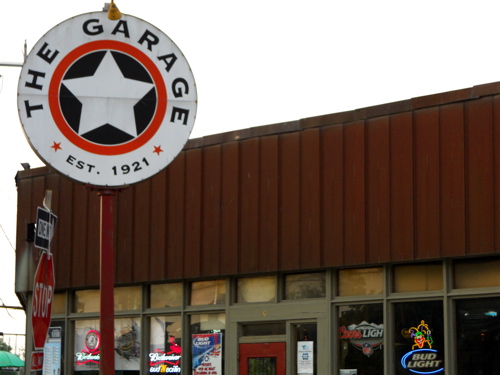
Just outside The Garage in Mobile, Ala., 9 S. Washington Avenue.

I had enough time left to visit one other spot. I wanted to hit a locals watering hole and opted for The Garage, located a block up from Wintzell’s.

The name reflects the previous occupation of this space. In fact there remains a commercial garage door that is rolled up on nice days to allow patrons to easily wander in and out of the establishment.

Fred was tending bar. With Happy Hour only minutes away, business was beginning to pick up rapidly. I explained why I was in Mobile and provided Fred several of the “I Am The Law” flyers, which he volunteered to put up in the bar.

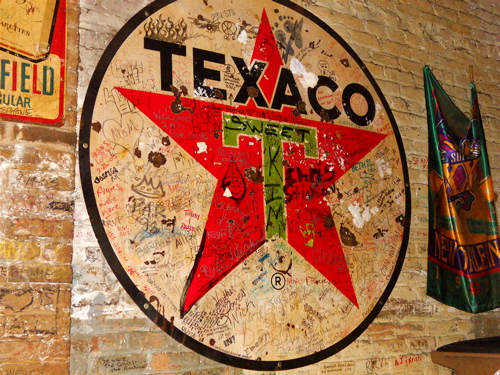
Part of the atmosphere inside The Garage, remnants from the buildings previous incarnation found against the back wall by the pool table.

There was no way getting around it, this was a dive, with high ceilings, a pool table and good tunes to complete the scene. It had slab concrete floors, so water and beer could easily be swept out the garage door. They also did live music – a band would be showing up shortly to rock through Friday night.

The crowd was decidedly local, and had a power crowd around for happy hour, including attorneys from the downtown law firms, politicians and their operatives, all hanging together with the regulars. By the time I was leaving folks were spilling out the front and around both sides of the building, where apparently drinks were allowed.

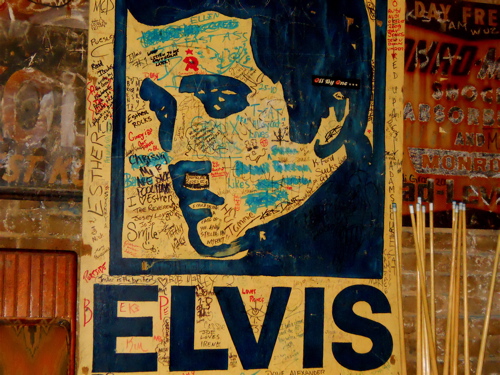
The spirit of Elvis is always present in The Garage.

This was all I needed from Mobile, food, drink, a bounty hunter and some hospitality. It’s a sleepy little city, with a comfortable downtown area that’s enlightened enough to keep folks interested, and sufficiently distracts from the troubles that can be found in the less hospitable areas.

Cotton Bayou Beach

I was ready to leave the confines of city life behind for a moment and make tracks for the beach. The thought of open spaces, the ocean and big tropical drinks sounded appealing. I had been chasing this reality television concept for a week, and was going to keep chasing it into Florida, but heard about the scene in Gulf Shores and Orange Beach and wanted to check it out since I was in the neighborhood.

There were two watering holes that particularly jumped out, LuLu’s at Homeport Marina and the Flora-Bama Lounge and Package.

Welcome to Orange Beach!

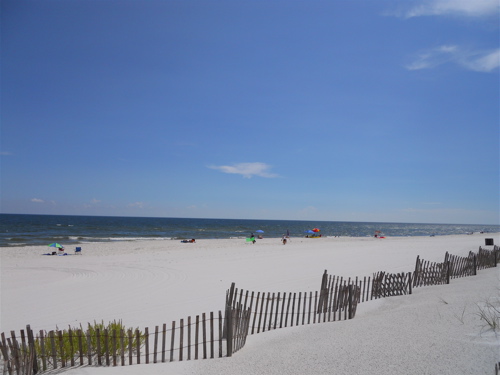
Across Mobile Bay and 45 miles down AL-59 is Gulf Shores. This is a seaside resort town of around 5,000 people, whose population greatly expands in the summer months, when the beach front hotels and condominiums are filled. The beaches here, and along Orange Beach and Perdido Key are famous for their bright “sugar white” sand.

Along the north shore of the Intracoastal Waterway in Gulf Shores is LuLu’s at Homeport Marina. This serves as the home base for its owner Lucy “LuLu” Buffett, the sister of singer/songwriter Jimmy Buffett, who owns a string of themed properties known as Margaritaville.

Drop by LuLu’s in Gulf Shores for a refreshing tropical cocktail.

LuLu’s is similar in look and feel. Its a beach-like compound by the marina, with multiple live music stages, vast restaurant seating and plenty of sand for volleyball and the kids. It’s pleasant enough, boats cruise slowly down the inlet, giving a honk and a wave. If you’re looking for a refreshing beverage, the Bama Breeze and LuLu’s Rum Punch are excellent on a hot day.

The place started as a high class dive, now it’s an entertainment empire and basically a huge tourist trap. LuLu’s offers the idea of a local marina dive, but it’s so commercialized and overly styled in full Margaritaville fashion, that it rings hollow.

Word of warning – stay away from the food.

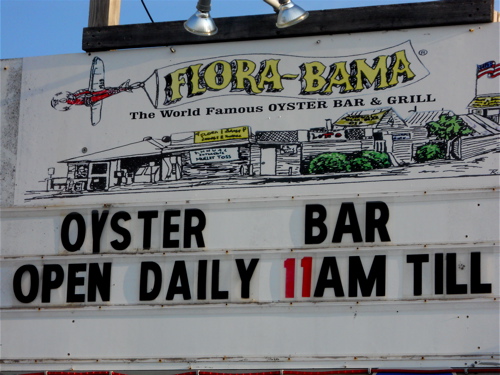
Oysters, lobster and all kinds of delights are available fresh daily at the Flora-Bama.

I did a grab-and-go on drinks and headed east to make sunset. Perdido Key and Orange Beach are only 20 minutes down the road from Gulf Shores.

Billed as the “last great American roadhouse,” the Flora-bama Lounge and Package resides on Perdido Key beach and is aptly named for its strategic position on the Alabama/Florida border. It’s actually slightly into Pensacola, Fla., but only by about six feet.

The ramshackle facade of the Flora-Bama’s main music hall belies the varied clientele within.

Originally constructed in 1964, this mostly outdoor establishment is really a series of multi-level connecting structures that prior to hurricane damage, consisted of 20 bars and space where four live bands.

Part of the allure is the crowd. It’s noted that patrons could sit with a millionaire to one side and a biker on the other. Many of the people imbibing this day were alumni from universities in the Southeastern Conference (SEC), as college football taunting was in full swing. The crowd was skewing older this early in the evening. There were a lot of late-30s to early-50s folks getting their drink on.

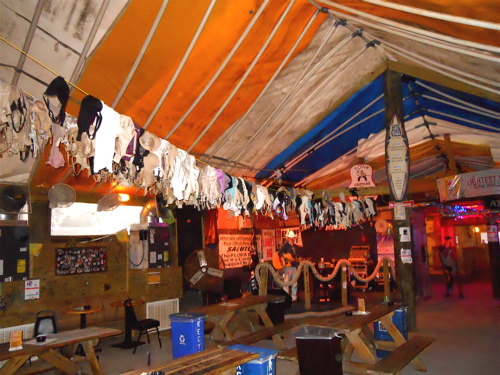
Womens’ brassieres line the ceiling in the main stage area of the Flora-Bama Lounge.

Judging by the howls from the ladies in the crowd, it wouldn’t be long before these cougars would be prowling the beach for young prey. As I walked into the main stage area, where the tented-ceiling is lined with bras that have been thrown over rope lines,  the band was offering up a free CD to whoever had the smallest penis. There were two men vying for this prize, with the winner actually brave enough to claim his victory. There’s no shame at the Flora-Bama.

Then Big Earl & Little Pearl lit into the catchy, “I got a half-hearted hard on to love you with tonight.” With poetry like that you can only expect big things from your evening.

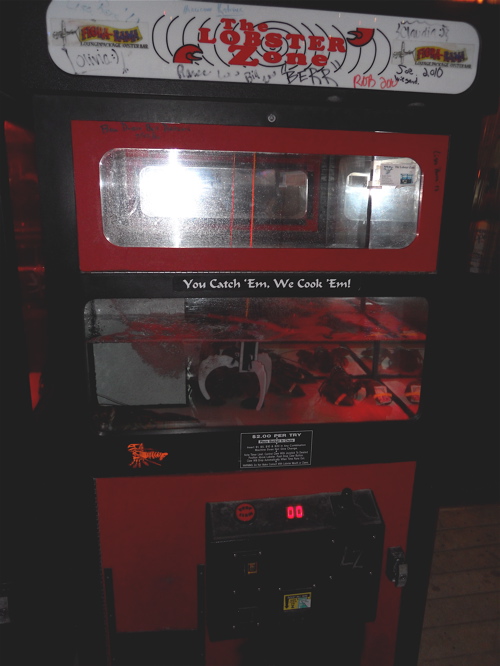
Take a shot at pulling out a live lobster…

I needed a moment away from the action to make a phone call, and came across the most bizarre contraption. It was an arcade game called The Lobster Zone. It was one of those deals where you put in the money and maneuver a claw over some objects and try to score one, only in this game the tank is filled with water and you’re aiming at live lobsters. The game glowed this deep red from the water tank and each crustacean had a $5 bill rubber banded to its claw. If you catch one the Flora-Bama will boil it up.

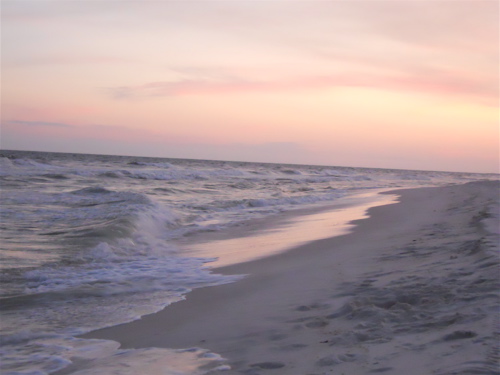
Outside the back deck is an immediate change in scenery. Music can be heard from the outside stage, but after traipsing down the long wooden walkway across the sandy beach, I was deposited before the ocean, only feet from the surf. Out here only the waves could be heard. I did have to watch for the occasional precision parachuter landing on the beach, but otherwise it was utterly peaceful as the sun dipped below the horizon.

The big event at this beach is the annual Interstate Mullet Toss, hosted by the Flora-Bama every April. With over 1,000 participants, there will be cars lining the road a mile in each direction.

The mullet toss involves taking a 1 1/2 pound bottom feeding salt-water fish and chucking it as far as possible. It’s a perfected art, and if done with skill, a mullet will sail 150 feet. The fish are recycled I was glad to hear, and told they routinely toss better than 300 pounds of these critters from the Florida side into Alabama.

To round out the festivities there’s a Ms. Mullet bikini contest, a wet t-shirt extravaganza, best “Hiney” competition, volleyball, skeet shooting, a keg toss, three bandstands and 17 bar stations.

As Jimmy Buffett likes to say, “the Flora-Bama Lounge & Package is the place your parents warned you about.”

The harbor view at the Wolf Bay Lodge.

That evening I had a great blackened Grouper filet at the Wolf Bay Lodge, and then took the advice of my server and went to HammerHeads night club in Orange Beach for the female Jell-O wresting matches. Sorry no photos, I couldn’t bring myself to record the event.

I went in to Pensacola the next day, but that was a nightmare of gaudy consumerism. After making a few inquiries for the realty show I pulled up my tent stakes and headed back home to New Orleans.

In the end the network decided to shelve the reality show “I Am The Law.” Their feeling was any portrayal of the bail bonding profession wasn’t unique enough considering the success of A&E’s ongoing program, “Dog: The Bounty Hunter,” which chronicles the professional life of Duane “Dog” Chapman, a bounty hunter in Hawaii.

I argued that the characters I found in the deep south are more real, and able to be related to by audiences because they’re more like regular people. The inherent danger of their job requires they carry firearms, where Chapman is unable to possess a gun because he is a convicted felon. These guys crack heads for real, and some have worked with Chapman’s people on cases, and all have extremely derogatory opinions of his work.

They operate in an unpredictable work environment, have destabilized home lives, often make questionable lifestyle choices and are half-crazy themselves, but remain enthusiastic about getting the job done.

Regardless of whether this story every reaches the airwaves or print publication, I’ve met some amazing people and found several great new places to play in the Gulf Coast region.

Besides how can you beat driving past the beach on a warm day with the windows down. Crank up the Lynyrd Skynyrd – it just sounds better in Alabama.

“Big wheels keep on turning/Carry me home to see my kin/Singing songs about the Southland/I miss Alabamy once again/And I think it’s a sin.”

Thanks for reading!

Posted in Food, Reviews, Travel | Tagged , , , , , , , , , | Leave a comment

Mobile and beyond

Bail Out Bail Bonds, across the street from the Mobile, Ala., city jail.

Coming out of Biloxi, Miss., Ben “Ray” Williams, the former biker gang member turned bounty hunter at D & D Bail Bonds, informed me of a father and son team that ran a pair of shops in Mobile, Ala., who did good work.

I started thinking about how the reality show could feature different teams of bounty hunters, that might interweave story lines so the show could change locations but continue a coherent story thread.

This swing through Mobile and into the panhandle of Florida is the final leg of my reality television journey. My plan was to visit a specific group of bounty hunters in Mobile, check out the city, then head into Florida briefly.

I had been gone from home for over a week now, and living on the road, while entertaining, was becoming a grind. Every day I had to chart a new town, find my path, dig up new contacts and be out of my hotel by 11 or noon at the latest. At which point luxuries like a desk were not available – I worked and lived out of my car.

It’s fun for a while. The work is engaging, I love meeting new people and investigating different towns, but I felt I had found what the production company was looking for already. These bounty hunters fit the criteria. It was time to go home.

Mobile is an old-world southern city. It began as the first capital of colonial French Louisiana back in 1702, and was colonized by France, Britain and Spain, whose influences remain present in Mobile.

A cruise ship docks to pick up its new passengers before heading for the Caribbean.

Located on Mobile bay, an hour from Biloxi, Miss. and two from New Orleans, Mobile serves as a vibrant shipping port and is an embarkation point for Carnival Cruise lines.

With a population of nearly 200,000, this is far larger than my target city, but it feels smaller and offers a classic southern setting with an urban twist to offset the quieter confines of Gulfport and Biloxi.

The downtown square is lined with trees and includes the requisite gazebo and park benches for lunch time eaters. Small businesses, law firms and a bank or two fill the outer ring around the green space. There’s a more locals-only part to the downtown area, some bars and restaurants that aren’t as easy to find and only allow those 21 and over to enter. Closer to the square is a more touristy section, where the university crowd goes to party.

Mobile is very picturesque and accessible. Many of the streets share the same names as those in New Orleans. But this town also has a seedy underbelly, full of drugs, poverty and crime that city officials work diligently to hide. I came to see both.

Bordering one side of the downtown area is the interstate exchange, which parallels Mobile Bay. The docks are over here, shipping repair and tucked neatly away off to the side is the city jail. This is not a pleasant looking establishment. I haven’t seen that much razor wire since the used car lots in SE Washington, DC. This is a nasty place and it’s evident they get plenty of business from the greater Mobile area.

Outside the fence line, the jail’s perimeter is dotted with numerous bail bonding companies. Most people drive right past these often sullen and shoddy establishments, never giving them a moments consideration.

An old rail car has been converted into two bail bonding shops.

The majority of our population goes a lifetime without ever needing a bonding agent, but for those who live and work in this world they witness a core constitutional guarantee playing out every day – the right to freedom.

Some never consider it because fronting money to get a loved one out of jail is a normal occurrence, while others are keenly aware of it.

It’s no coincidence pawn shops are often located not far from bail bonding locations. Many times freedom comes down to money in the legal world. People will sell whatever they’ve got to pull together money for bail.

Budget cuts in schools, lack of police on the streets, lack of prevention programs, poor economy, ill-conceived abstinence programs – what are only words and rhetoric in a politician’s sound bite get played out for real in cities like Mobile.

A bonding agent is the immediate arbitrator between a person sitting in jail or being released. It’s only temporary, final arguments will go before a judge, but with the court system being slowed by overcrowding and bureaucracy, nobody chooses to wait in jail until their day in court. Usually 10 percent of the full bond amount is required in order to make bail. If that kind of cash can’t be pulled together it’s time to talk to a bondsman.

It can be dead quiet inside a bail bonding office, or a cluster of activity; moms crying, money being pulled together by family members or friends, bonding agents switching hats to become fugitive recovery agents, bullet proof vests going on and weapons being loaded.

Like law enforcement, bounty hunting can go from boring to deadly in a heartbeat.

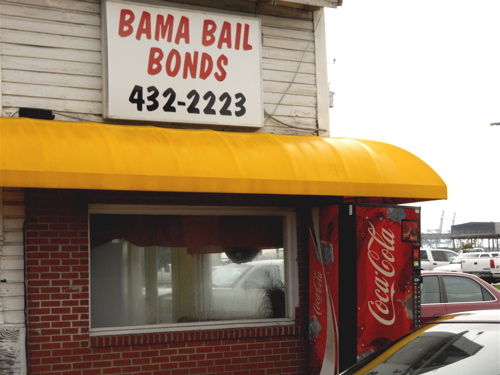
Bama Bail Bonds is conveniently located across the street from the city jail in Mobile.

Directly across the street from the jail sits Bama Bail Bonds, right on the corner. The guy I was looking for was next door at Best Bail Bonds – he runs both. There were a couple people hanging around in the shop, and a dog was sitting on the floor by the door. An animated figure was arguing tersely with someone on the phone. I was told he’d be with me in just a minute.

Michael Breland appears rather average at first glance. He’s 5’8″, 180 pounds, with thinning hair and these intense bug eyes that stare out from behind thick lensed wire-framed glasses, turning yellow from age.

Breland, 47, stood up and warmly greeted me. It was upon closer inspection that he became more intimidating. He was wearing a wife beater, with a winged tattoo extending out across his chest. Other tattoos were visible on his neck and down his arms. A heavy chain necklace, with a scorpion medallion hung around his neck. He had on a pair of jeans with a knife clipped in one pocket and a bottle of prescription pills sticking out of the other.

We shook hands and I noted Breland’s huge sausage fingers attached to mangled hands that appeared to have been punching concrete walls his entire life.

Michael isn’t overtly imposing, but he is convict scary. He has that look – like a guy in prison. He has to deal with those kind of people and handle violence up close and personal. He’s prison hard.

Police officers sometime have this sort of feel because many of their clients are felons as well, but they also have to assist the public and direct traffic, responsibilities that help mellow their exterior. Bail bondsmen only deal with those who have been arrested, and must live and operate in that world, and think like fugitives think.

“My first case was a robbery in Jones County Mississippi when I was 17,” said Breland. “I talked the bondmen into letting me take the case after several so-called bounty hunters tried to track the suspect down and failed. I had him in three days. I found him after several officers searched a mobile home and came out saying he wasn’t there. I went into the trailer and he was hiding in the very back bathroom sink cabinet. So that’s where my journey began, and here I am 30 years later.”

These boys roll hard, tactical gear, sawed-off shotguns – they go where the police refuse to go. Breland and his crew use a lot of trickery to get the job done; fake voices, disguises, whatever is necessary to get into the house and make the apprehension.

Something to remember is this type of work doesn’t always go the way it should. The commotion in Breland’s office when I arrived stemmed from an incident the night before.

Two of his guys had gone to pick up a fugitive at a gated apartment complex, but they had been made as they drove up. A code was required to get through the automated gate, and the fugitive’s friends pulled a car up in front of the inside of the gate, and when Breland’s guys put in the code another car came up from behind and blocked in their car so they couldn’t move.

Even though the fugitive recovery agents were armed, the bad guys got the drop on them, and they were robbed at gun point by four men. It could have been worse.

Breland cautioned me that if we did use his crew for our reality television show, there would be many illegal deals going down within camera view, especially up in the Pritchard area, which is an African American neighborhood.

A significant percentage of Breland’s overall clients and his fugitives come from Pritchard. It’s an area that has a lot of neighborhood bars, gay bars, strip clubs, and prostitutes (male and female).

Best Bail Bonds is the other bonding company Michael Breland runs, and is located next door to Bama Bail Bonds.

Between Bama and Best Bail Bonds, Breland averages 200 bonds per week, of which about 90 never show for court. So he and his crew have to go find them, week after week.

There’s a large board in Michael’s office where he posts all the fugitives with they’re last known whereabouts. Typically they operate between New Orleans and Florida, that’s where most of their fugitives are found. But I noticed there was one name on the board last seen in Kentucky.

Breland turned me onto three other hard dudes that work in surrounding states. My thought was if the show works and gets picked up, we could branch out and change locations. This way we would already have familiar people in several different cities.

I also liked the hook that Breland had a son in the business with him. Chris, 26, works out of the same shop. He was out trailing a guy in Florida, so I didn’t get to meet him, but I’m told he’s a real bulldog.

Posted in Travel | Tagged , , , | Leave a comment