The Born Builder: Dal Loiselle, Building Sustainable Green Structures

An architect's rendering of the Sustainable Living Center at Maharishi University of Management in Fairfield, Iowa, where Dal Loiselle served as the construction manager.

An architect’s rendering of the Sustainable Living Center at Maharishi University of Management in Fairfield, Iowa, where Dal Loiselle served as the construction manager.

“I was born to be a green builder,” declares Dal Loiselle.

That’s not mere hyperbole: Both Loiselle’s parents suffered from chemically sensitive allergies, which he inherited, and led to his growing up in custom-constructed homes whose building materials were carefully selected to avoid provoking further family health problems.

Nor did the family considerations stop there. “When I grew up,” Loiselle says, “I married a girl who had similar allergic sensitivities and her parents were both real estate brokers so I couldn’t escape this business.”

No surprise, then, that for over 25 years, Loiselle has been working in real estate development. He’s now president of Evergreen Homes and Developments, a company based in Fairfield, Iowa, that markets and sells log, timber frame and panelized homes and buildings and develops real estate projects using these materials and methods.

Loiselle got his start in the business buying and renovating single-family homes and selling them. He then moved on to improving apartment buildings, employing the material and protocols that would avert symptoms he knew so well – runny nose, stinging eyes and headaches.

But it took years, he said, to convince investors and other real estate professionals of the promising market for new construction of natural, nontoxic homes.

Loiselle’s first green project built from scratch was a 1989 ocean block condo in Dewey Beach, Delaware. His company is currently building the Sustainable Living Center for the Maharishi University of Management. This building is expected to surpass all Leadership in Energy and Environment Design, (LEED), construction standards.

Initially, he observes, his green building career was a personal necessity, but the need has grown much larger. “I didn’t have a choice, it was a matter of survival,” says Loiselle. “I think we are approaching that point on a global level now, where it is a matter of survival for all of us, and the planet.”

His tone is not one of gloom-and-doom, but of hope: “I think that we are getting it,” he adds, “and I am optimistic that we will all survive and thrive.”

#     #     #

Part of a special report entitled, Degrees of Green: Exploring the State of Iowa’s Environment.

Published by:  The Daily Iowan | 05-02-08

Posted in News, Politics, Travel | Tagged , , , , | Leave a comment

From the Ground Up, Green Buildings Shine

The headquarters of HNI in Muscatine, Iowa, environmentally designed by OPN Architects.

The headquarters of HNI in Muscatine, Iowa, environmentally designed by OPN Architects.

Iowa City, IA – In 2006, OPN Architects of Cedar Rapids worked with Gensler to design a full renovation of an abandoned 1920s-era building in downtown Muscatine to serve as the corporate headquarters of HNI, the world’s second-largest office furniture manufacturer. The floors are recycled, the urinals are waterless and a highly efficient heating and cooling system delivers climate control at a reduced cost.

In recognizing the need for additional office space, HNI seized the opportunity and upgraded to an environmentally certified building, while maintaining its downtown Muscatine presence. The company has set a corporate goal of achieving sustainability in all its facilities and felt its new headquarters was the best place to start.

The Environmental Protection Agency estimates that homes and businesses account for nearly half the total energy use in the United States and 38 percent of carbon dioxide emissions. The average home emits twice the greenhouse gases of an automobile. The recycled HNI headquarters consumes 10 percent less power than the company’s previous building of a similar size.

“Our building has been a tremendous success story,” said Glenn Stelzner, HNI’s corporate facility manager. “We’re getting a lot less complaints from employees about air quality due to the use of non-toxic materials in our new building, and the natural lighting is great.”

Cradle-to-Grave

Natural lighting help illuminate the interior of HNI's headquarters.

Natural lighting help illuminate the interior of HNI’s headquarters.

Constructing a high-performance green building requires taking into account the entire life cycle of a structure, from design to removal, often referred to as cradle-to-grave. This philosophy considers location, surroundings, construction materials, energy consumption, indoor air quality and environmental impact.

To codify the relationships among these concepts, the non-profit U.S. Green Building Council (USGBC), a sustainable building practices group, unveiled its Leadership in Energy and Environment Design, or LEED, certification program in 2000.

The program awards points for reaching benchmarks in six categories, such as water efficiency and indoor environmental quality. A project requires at least 26 points, out of a possible 69, to qualify for the lowest of four levels of certification, starting at basic and continuing through silver, gold and platinum.

Since its unveiling, LEED has stood as the standard for the design, development and operation of environmentally conscious buildings.

En route to earning a LEED silver certification for the HNI headquarters, OPN diverted 75 percent of construction waste from the landfill and optimized the use of daylighting, with 78 percent of the building receiving natural light.

Utilizing building placement to take advantage of natural lighting, sun light and shade are keys to designing a LEED certified building.

Inside HNI’s headquarters.

“LEED made sustainable design comprehensible and quantifiable to the public,” said architect Steve Knierim, of OPN. “The program opens the door to have extended conversations with clients regarding sustainability.”

While the technology behind the program may be state-of-the-art, many of the concepts are based upon architectural practices in use for decades. Sanjay Jani, owner and lead architect at AKAR Design in Iowa City, said he has combined elements of nature and beauty in construction design since 1991.

“Green should just be common sense,” said Jani. “If you position a building to take maximum benefit of sun and shade, that saves so much without using any alternative energy solutions.”

Green architecture takes the core elements found in the LEED program and adds functionality for occupants, while paying attention to aesthetics that will combine nature, beauty and sustainability into a financially affordable structure.

A LEED-certified building can be completed for about 2 percent more in upfront costs than standard construction practices, according to a 2006 study by Davis Langdon, a construction cost-planning and management company.

Certain green upgrades are initially expensive. The cost of a geothermal heating and cooling system, which taps into the constant temperature of the earth’s subsurface, is two to three times more expensive to purchase and install than a conventional one. Yet such a system pays for itself in about seven years.

While much of the LEED program is straight forward, some have complained that points awarded for certain green practices don’t match their costs or benefits. A photovoltaic solar energy system, that can produce electricity, for example, starts at around $40,000. This currently earns the same number of LEED points as installing a bike rack.

The system may not be perfect, but the LEED program has been instrumental in bringing attention to sustainability in the commercial building and real estate markets.

Green architecture’s leading advocate in the United States is the federal government, which uses LEED specifications for all new construction projects and sustainable upgrades.

“Architects have partly gotten on board because the government is one of the biggest consumers in the country,” said Tony Nash, an architect with AKAR Design. “If your firm is LEED-certified, it gives you a leg up on the competition.”

The LEED-certified James Van Allen Elementary School in North Liberty, Iowa.

The LEED-certified James Van Allen Elementary School in North Liberty, Iowa.

All the architects at Neumann Monson Architecture in Iowa City are LEED-certified. They designed the James Van Allen Elementary School in North Liberty, the first LEED-certified public school in Iowa, earning enough points to reach the silver level.

“We relish the challenge of sustainability while being aesthetically pleasing,” said Scott Palmberg, an architect with Neumann Monson.

Meanwhile, some homebuilders are trying to educate consumers about available green technologies and the wisdom of up-front investments in energy-saving home improvements.

The intention is to establish a market value for green-certified homes and businesses, analogous to Consumer Reports’ ratings of automobiles.

With LEED, “we are changing the focus to where it needs to be and keeping the focus throughout the planning, building and finishing process,” said Neumann Monson architect Chris DeGroot.

The Vedic Way

An architect's rendering of the Sustainable Living Center at Maharishi University of Management in Fairfield, Iowa.

An architect’s rendering of the Sustainable Living Center at Maharishi University of Management in Fairfield, Iowa.

In Fairfield, home to the Maharishi University of Management and center of the Transcendental Meditation movement in the United States, modern green-friendly practices have been combined with an ancient building method originally found in India’s Vedic architecture to create buildings and residential neighborhoods that are highly energy efficient.

Vedic architecture focuses on a building’s orientation, proportion and room placement so it is in line with the progression of the sun and takes maximum advantage of the heat, shade and natural light.

“Maharishi Vedic architecture looks at designing buildings that are in harmony with natural law,” said Jonathan Lipman, a leading Vedic architect and director of the Institute for Maharishi Vedic Architecture in Fairfield.

Properties in the Abundance Ecovillage draw their electricity from wind and solar, and use as little as 100 kilowatt-hours per month. A similar-sized conventional home in this area uses about 10 times that power for the same services.

“Once people build homes based on their needs instead of about ego or image they will make more intelligent housing choices,” said Dal Loiselle, founder of Evergreen Homes and Development in Fairfield. “I can build a house now for the same price as before but it costs one-third to run if using green.”

Buildings in North America contribute over 2.2 billion tons of carbon dioxide to the atmosphere yearly. The construction of green-based housing and retrofitting of older homes could save 1.7 billion tons of CO2 annually, according to a new report from the Montreal-based Commission for Environmental Cooperation. The Green Building Council estimates that by 2010 approximately 10 percent of commercial construction will be green.

“We may have gotten on the bandwagon late, but they didn’t account for the resiliency of nature,” says developer Loiselle. “Once you stop negative actions, the bounce back is dramatic.”

#     #     #

Part of a special report entitled, Degrees of Green: Exploring the State of Iowa’s Environment.

Published by:  The Daily Iowan | 05-02-08

Posted in News, Politics, Travel | Tagged , , , , , , , , , , , , , , , , , | Leave a comment

The Who’s “Tommy” Falls Flat

bostommyIf only I were deaf, dumb and blind…that might have made last Friday evening’s sophomoric performance of “Tommy” sufferable.

The Catalyst Acting Company’s rendition of The Who’s venerable rock opera opened at the Englert on the wings of pigeons, soaring straight into the dumpster.  Mercifully its run is only four performances.

I bash because I care.  The origin of this current theater production of “Tommy” dates back to The Who’s double album release of the same name in 1969.  The album spawned a movie in 1975, and 18 years later “Tommy” was adapted into a Broadway play.

The driving force behind all of these incarnations is The Who’s guitarist, Pete Townsend, who conceptualized “Tommy” and wrote most of the material.  Unfortunately something was lost in translation between the original concept and what was unleashed upon the public here Friday.

“Tommy” involves a young boy who witnesses the accidental murder of his mother’s lover, by his father, after he returns home, unexpectedly alive, from World War I.  The trauma of this event, and his parent’s insistence that he saw nothing, renders the child, deaf, dumb and blind.

Throughout his childhood Tommy endures taunting and abuse, both physical and sexual, at the hands of other children and relatives, but remains silent until discovering a pinball machine.  Tommy, as a “Pinball Wizard,” achieves international celebrity.

Once the boy, now a young man, is freed from his affliction, Tommy assumes a messianic character, and followers flock to his religion, highlighted by the rollicking “I’m Free.”  This movement subsequently comes crashing down after the disciples reject Tommy’s demands and a revolt ensues in the closing number “We’re Not Going To Take It.”

The themes of alienation, despair and swipes at organized religion are what made the original “Tommy” resonate, and continue to land the album among the most influential recordings in rock history.  The highlights remain in this current version but are obfuscated by deficient talent.

The lead, played by Sean Nollen, is an admitted amateur, and remains painfully insignificant in this role.  His voice and presence are better suited for dinner theater on a riverboat.  Tommy’s father, Captain Walker, played by Jeffrey Mead, was a bright spot and one of the few voices capable of rising above the cacophony.  There also is a notably campy scene with Tommy’s Uncle Ernie, played by Chris Carpenter.

In the end the show was stolen by a first grader, Colby Kaplan, who plays the 4-year old Tommy, and a sixth grader, Grant Blades, who plays the 10-year old Tommy.  They share the perfect mix of benign Damien-like manifestations and cuteness that enabled them to secure the lion’s share of the audience’s applause.

The band backing this performance was sufficient but the equalization between their volume and the vocal ability of this ensemble was woefully out of balance, leaving many numbers muddled.

The cast and musicians gave an honest and heartfelt performance, but lacked the ability necessary to make a production like “Tommy” successful.  On the plus side The Englert does have a bar in the lobby and I was quite capable of drinking away the pain.

Posted in Music, Reviews | Tagged , , , , , , | Leave a comment

Iowa University Police Take Charge

Iowa City – In the year since the Virginia Tech massacre, college administrators have wrestled with how to adequately address student safety on campus. Many are turning to university law enforcement, requesting an increased presence by officers on campus. To make this possible, campus police departments are receiving enhanced training and funds allocation to upgrade equipment and facilities in hopes of avoiding another tragic school shooting.

In response to this security challenge the University of Iowa police department (UIPD) has undergone a comprehensive transformation resulting in an all-encompassing improvement in the department’s professionalism. The culmination of this transformation came on October 31, 2007, when in response to the Virginia Tech shootings the Iowa Board of Regents approved arming officers at Iowa’s three public universities for the first time in 40 years.

Until the late 1960s Iowa’s public university officers carried firearms. At the height of Vietnam War protests a decision was made to remove firearms from this politically charged environment for philosophical reasons. Since 1969 officers have only had non-lethal force at their disposal for carrying out their law enforcement duties.

Iowa’s universities are not unique in seeing these changes come to their public safety departments. “There is a national trend to militarize campus law enforcement,” says Robert McCrie, a 37-year veteran of the study of law enforcement and professor at John Jay College, in New York.

In reality, the university police were already firearms certified. “The officers at the University of Iowa go through the same rigorous certification process and academy training as any other state or local Iowa law enforcement officer,” says UIPD Associate Director Dave Visin, who has been with the department since 1987. In fact, UIPD officers qualify twice yearly in weapons training, although the state only requires a single test.

The department has been provisionally armed since 2004, which allowed for the deployment of weapons on a pre-approved basis. “The problem with provisional arming is it’s ineffective unless you know about the danger ahead of time,” says William Searls, a UIPD associate director and 17-year veteran of the Coralville police department.

Within three weeks of the Iowa Regent’s vote UIPD officers reported for duty equipped with Sig Sauer P229 .40-caliber semi-automatic pistols. Officers at Iowa State carry the same gun, while the University of Northern Iowa selected the .40 caliber Glock 22 pistol.

In February Iowa and Iowa State made the decision to change the handguns they carry to the .40 caliber Smith & Wesson M & P, due to its interchangeable grip, accuracy, weight, and additional magazine capacity. There also is a desire to follow the lead of Iowa’s state troopers, who have been carrying the Smith & Wesson pistol for more than a year.

The changes now in place at the UIPD began in 1995 when Charles Green was selected to become the director of the Department of Public Safety (DPS). Under Green’s direction the public safety budget has increased from $2.57 million in 1999 to a projected $4.62 million this year. The force consists of 34 sworn police officers. Additionally, full-time security guards and part-time student guards handle routine campus security and staff the art museum’s security needs.

“Being part of a university police department is different from a municipal police department; it serves a different community,” says Director Green.

Typically, campus law enforcement is an entry-level position for people seeking law enforcement careers. This makes recruitment of quality candidates and retention of current ranks an ongoing struggle for any campus department. Younger officers in particular, looking for real action, are hard to keep.

“There were officers at UIPD before that that I would have been hesitant to clear a house with, from a competence level,” says Sgt. Troy Kelsay, a 21-year veteran of the Iowa City and Coralville police departments. “They have since gotten the deadwood, dead branches, to shake off the tree. Director Green is to be credited with the changes at UIPD.”

In 2001 Green fought for and secured the designation of “police department” for the DPS. To emphasize this change, new black uniforms were purchased, the squad cars were repainted black and white, and all signs and patches were replaced to indicate the police department title.

Although the university is committed to becoming the employer of choice for individuals seeking law enforcement careers, currently the UIPD is the lowest paid of the four Iowa City area police agencies, with a beginning salary of $34,682 before certification. Upon successfully completing academy training the salary increases to $36,248. Only $2,300 separates the university’s post-certification starting salary from that of the Johnson County Sheriff’s Department, which offers the area’s highest starting pay.

#     #     #

Published by:  Police Magazine | 03-20-08

Posted in News | Tagged , , , , , | Leave a comment

Cloverfield Eats Itself

cloverfield-2-1024Whoa New York just got messed up!  I thought Manhattan was still in a post-9/11 moratorium from Hollywood monsters, but don’t tell that to Lady Liberty.  Her head was last scene bouncing down a Soho street.

After an impressive amount of hype Paramount Pictures has finally unleashed Cloverfield upon the general public.  The movie itself is a classic monster flick.  From out of a calm New York night an insidious creature attacks the city, dining indiscriminately upon her glitterati.  That part is straightforward enough.  The real buzz with Cloverfield has to do with how it was shot and the build up prior to its release.

The story centers upon five New York hipsters who are throwing a going away party for their friend Rob, played by Michael Stahl-David.  The film opens with the statement that case designate “Cloverfield” has been seen multiple times, referring to our protagonist – the Monster, and that the following video was recovered at incident site U.S. 447, formerly known as “Central Park.”

The hook for this film is it’s shot from the perspective of a hand-held video camera.  Absolutely reminiscent of The Blair Witch Project, and presents the movie as if looking through a camera’s viewfinder.  This includes every shake, shock and bump.  Note to self: tacos and beer NOT the best combo before seeing Cloverfield.

During the going away party, a strong tremor is felt throughout Manhattan and soon after the Monster makes his appearance.  Cue fly-by of Statue of Liberty’s head, a referential nod to John Carpenter’s 1981 film Escape from New York.

The pacing and outcome of this film are never in doubt.  The other cast members are T.J. Miller, Jessica Lucas, Odette Yustman, Lizzy Caplan and Mike Vogel.  You’re not supposed to know who any of these people are so don’t ask.  This way they can be killed off at strategic moments when the movie drags.

More intriguing than the movie itself is the viral marketing campaign Paramount Pictures carried out prior to the release of Cloverfield.  The first promos were seen before the Transformers movie in July 2007.  No title was attached only a date, 01-18-08, which was Cloverfield’s release date.  The Web site (www.1-18-08) was built around this date and offered time-stamped photos as clues to the film.  Then other sites popped up.  One for Tagruato (www.tagruato.jp), a Japanese deep sea drilling company and another for a Japanese happy drink, Slusho! (www.slusho.jp).

It was learned on Tagruato’s Web site that one of its fictitious drilling platforms had been destroyed off the coast of Connecticut.  A statement from the company’s president confirmed this and canned news footage of the platform disaster became available.

Slusho! turned out to be a registered product of Tagruato, which led people to the parent company site.  Those who signed up for Slusho! information received fictional sonar readings as the Monster made its way to NYC for Cloverfield’s opening weekend.

This campaign was the brainchild of producer J.J. Abrams, writer Drew Goddard and director Matt Reeves.  Abrams, who wrote the Armageddon screenplay, is a writer and producer, along with Goddard, on the television shows Lost and Alias.  These two utilized a similar viral campaign to hype the third season of Lost.

As a side tidbit, Slusho! was a featured beverage on Alias, which tipped many off to part of this campaign.  Also included in the Cloverfield experiment were MySpace pages for each of the actors, with final updates ending on 01-18-08.  They even went to the trouble of editing Hud’s site, played by Miller, to reflect his change it height to 2’6” after evidently being bitten in half.

Prior to Cloverfield a similar campaign was used to great success in building buzz for the opening of The Blair Which Project.  Also, the woeful Snakes On A Plane tried this technique but nothing could keep that film airborne.

The build up to this film proved extremely effective in creating a sense of depth behind the screenplay and its characters.  Unfortunately Cloverfield has trouble surviving the hype.  When the screen finally goes blank and the first credits roll a collective sigh of disappointment is uttered by all in the theater.  The film’s only 85 minutes but feels longer.

Posted in Reviews | Tagged , , , , | Leave a comment

VOOM Portraits Impress

preview_352x288Ah, Dita von Teese, half-naked on a trapeze — that warms a cold February morning.  If high-definition burlesque is up your alley I suggest strapping on your snow assault equipment and setting a course for the University of Iowa Art Museum.

After stops in New York and Los Angeles, Robert Wilson has brought his traveling video cabaret to Iowa City for an exhibit lasting through March 30.  VOOM Portraits consists of more than 50 video images, presenting a mixture of celebrities, unknowns and animals into often heavily contrived contexts of the artist’s vision and creation.  This collection is the result of a two-year collaboration between Wilson and Voom HD Networks, a U.S. based high-definition television provider.

Wilson, 66-years-old, is a multi-talented avant-garde visionary, surrealist, playwright, sculptor and director.  Born in Waco, TX, and based in New York currently, Wilson was an artist in residency at the University of Iowa Center for New Performing Arts in 1970.  This Iowa connection was instrumental in helping the UI Art Museum secure such an ambitious exhibit.

With VOOM Portraits Wilson creates a hybrid of video performance art.  He offers up numerous well known personalities, but confounds the MTV generation by abandoning their jarring quick cut scenes in favor of slowing down perspective to allow for the most minuscule gesture to be exaggerated into grand scope.  A blinking eye, a tapping foot or a simple smile takes on dramatic significance in Wilson’s world.  He knows precisely what he is after and takes the time to achieve it.

wilson_1Some of the better known participants include Mikhail Baryshnikov, Johnny Depp, Salma Hayek, Steve Buscemi, Sean Penn, Brad Pitt, Winona Ryder, and Kool (the Snow Owl).  The presentation offers continuously run video loops shown in high-definition format on flat-screen plasma televisions, each roughly the size of a refrigerator door.  Some only run a couple minutes before repeating, others run upwards of 20 minutes.

To make this work each scene is meticulously choreographed.  It took about a day to shoot each video and a crew of 30 to make it happen.  Wilson enjoys playing upon the natural or created back story each subject embodies.  Brad Pitt with a gun, Dita and her, well…assets, or Johnny Depp’s feminine beauty, are subliminal characterizations that fans of these celebrities bring with them into this show.  Wilson smartly exaggerates these stereotypes and packs the settings around each subject with comparative symbolism to sear each subject’s persona into a visual story.

The technical aspects behind each piece are superb.  The make up, costumes and strategic lighting allow each image to leap from the screen.  But in the end it’s the sounds that make this show pop.  The images are sublime eye candy, but the score for each piece solidifies the moment.

voom-portraits-le-celebrity-video-ritratte-da-bob-wilson-a-palazzo-reale-16isabellarosselliniLayout is crucial for VOOM Portraits.  Due to the soundtrack attached to each image sufficient space is necessary to allow the sound to roam.  And roam it does.  By design Wilson anticipates the proximity of one piece to another and how their sounds will intertwine.  The result is a carnival arcade atmosphere.  Maniacal laughter, ominous chanting and cries in the dark entice patrons from one image to the next.  The dripping water and shrieking owls are balanced by undertones of classical compositions and demented nursery rhymes.  All of these sounds undulate and cascade into a visual soundscape that compliments their video counterparts.

Aesthetically this is a pleasing exhibit to wander.  The UI Art Museum is to be commended for triumphing over this challenging exhibition.  The majority of the museum’s permanent collection had to be removed and the exhibit space reconfigured to accommodate the expansive VOOM Portraits.  The result is an open and spacious feeling as one navigates this showcase, which is helpful due to the darkness required for this medium.  Only a few overhead lights are present.  The remainder of the lighting is handled by the video portraits themselves, heightening the visual experience.

ImageAlthough visually stunning and technically superior, these images can move at a glacial pace.  There is a constant enticement to the viewer of danger, a tease of some impending train wreck, but none materializes.

Wilson chooses to play it safe with his glitzy subjects and leave interpretation to the viewer.  A potentially more compelling concept would have been to place a cast of unknowns into these similar settings, leaving the outside baggage of stardom behind.

Regardless this is an extremely enjoyable viewing experience and reminds me that I must get an owl room installed immediately.

Posted in Events, Music, Reviews | Tagged , , , | Leave a comment

September 11: In Retrospect

New Yorker2 081108 - spiegelman-cover_thumb_w_580

Art Spiegelman’s tribute to the lost towers in New York.

An exciting new exhibit was unveiled in the W340 Gallery of the AJB this past Friday.  Two works taking a symbolic look at the tragedy of the September 11th terrorist attacks were placed on a limited display.

Casting a somber mood across the room was the cover art from the first issue of the New Yorker magazine post-9/11, created by New York based artist and comic illustrator Art Spiegelman.  The shadowed black towers of the remembered World Trade Center are cast ominously upon a pale black background.

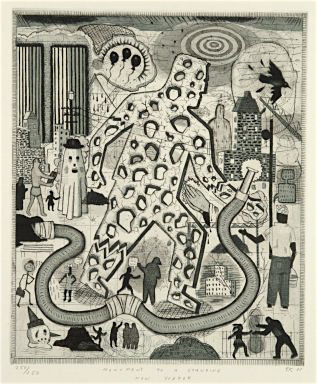
Contrasting this feel of a funeral procession from Spiegelman is a piece by Chicago mixed media artist and poet, Tony Fitzpatrick.  Well known for producing album cover art, such as Yellow Moon by the Neville Brothers, and for mixing found articles and cartoon-like characters in his art, Fitzpatrick’s take on September 11th in Monument to a Standing New Yorker has a complexity that commands a viewer to pause and contemplate the powers at work.

A flatly drawn, two-dimensional male figure dominates the forefront of this piece.  He has a similar appearance to a chalk outline from a crime scene brought to life, perhaps consisting of concrete, but cracked and riddled with holes.  Jagged breaks are apparent in his arm and leg, yet he attempts to harness a fire hose that snakes through the bottom of the frame.

Although this figure makes a cutting appearance, the viewer’s eye is drawn to the upper left corner, where the twin towers reside.  A ghost in a top hat floats amongst other figures and smaller brick edifices, and a disturbing trio of black balloons fly to the sky beside the doomed towers.

What this all means is left to the individual, but the overall appearance of this image is worn and tattered, like New York itself.  Both works are effective in conveying a message of import concerning 9/11, and they share the use of symbols to tell their tale.

Spiegelman reduces the actual towers to renderings, replica shadows of what previously stood.  The image conveys a sense of mourning, and is symbolic of the loss felt by America and emblematic of the absence of the twin towers from New York’s fabled skyline.

The simplicity of this image belies its underlying complexity and that is what makes its statement so poignant.  No deciphering is necessary, no decoding required.  It’s easily understandable.  This image could be shown to a six-year old, a foreign tourist, or a farmer from Nebraska and all would immediately grasp its meaning.  A viewer is left with no room for interpretation and none is expected.

Spiegelman’s presentation also allows the New Yorker to produce a cover referential to September 11 without betraying its artistic style.

Tony Fitzpatrick | Monument to a Standing New Yorker

Tony Fitzpatrick | “Monument to a Standing New Yorker”

While Fitzpatrick’s image requires a viewer to spend more time absorbing all that is being conveyed.  New aspects reveal themselves as one looks at the print in more detail.  This drawing is a conglomeration of symbols, each telling a piece of the story that collectively speaks to the greater impression left in the wake of 9/11.  Absent an explanation by the artist, a viewer could feel shut out by the messaging shared between the artist and his subjects.

It isn’t necessary to be alienated by Fitzpatrick’s telling, it just necessitates a moment for everything to be processed through the eye and into the mind.  The images will pass along an unspoken meaning to each viewer, to be assembled as one sees fit, leaving considerable room for interpretation.

Having only seen Monument to a Standing New Yorker briefly, I’m curious what it will say to me the next time we meet.  I recall the New Yorker’s cover from its original publication, and it is as striking now as it was in 2001, but can only be read one way.  Fitzpatrick’s work allows the mind room to roam and what it will unveil upon later viewings remains a mystery.

Posted in Events, Reviews | Tagged , , , , , | Leave a comment

Shredding the Pea Patch with Music Critic Jim Musser

thIn January of 1997 Pat Boone released a comeback recording of sorts.  With God in his heart and leather on his mind Boone paid homage to several heavy metal classics on, In A Metal Mood – No More Mr. Nice Guy.

Jim Musser responded to this natural disaster on behalf of music lovers everywhere in his February ICON magazine review entitled, That Giant Sucking Sound.  Cutting to the heart of the matter Musser declared, “Only an asshole would buy this record, just as only an asshole could have made it.”

Boone responded tersely comparing Musser to a ‘dung beetle.’  Having drawn such malevolent praise from the likes of Boone, Musser felt a career as a rock music critic might have possibilities after all.

Jim resides in a cramped ground floor apartment on the east side of Iowa City.  It’s a simple life and he likes it that way.  Compact discs cover most every open surface.  Two stacks of CD’s sit atop the television still awaiting review.  Behind the CD’s are albums.  Not as many as before.  There had been over 6,000, but moving them became too difficult and most were discarded.

Flanked by framed pictures of Miles Davis and Johnny Cash, Musser assumes the mantle of music guru.  At 55-years-old he’s put on a pound or two, the beard is graying, and his knees have seen better days, but a rebellious glint remains in his eye.

Next year will be Musser’s tenth anniversary of providing musical commentary for the Iowa City Press-Citizen.  It’s been responsible for paying his rent ever since he took the job in April of 1998.  He’s also been a contributing writer to No Depression, a bimonthly music magazine out of Seattle, for about the same length of time.  These are jobs he holds in addition to being a school bus driver and a full-time dad.

Although known for his insightful commentary Musser is a music fan first.  The writing is a manifestation of his passion for the music.

Raised in Hampton, IA, Musser began writing album reviews as a form of entertainment when he was a young teen.  His father exposed him to the likes of Cab Calloway, Artie Shaw, Duke Ellington and Frank Sinatra.  His sister and her teenybopper girlfriends took care of the popular music angle, spinning Chuck Berry singles whenever they babysat him.

After initially attending Central College in Pella, Musser followed his eventual first wife to the University of Iowa.  The college thing didn’t work out, nor did the marriage, but Iowa City had a solid underground music scene and this allowed for further expansion of Musser’s musical horizons.

He took a job with BJ Records, a well-regarded local music store, and had a slot in the rotation at the university’s radio station, which together provided him sufficient musical nourishment.

“We were always doing lists on what or who was best, you know best guitarist, drummer or band,” said Musser.  “It’s not meaningful, but it makes you listen closer.”

It was about finding that undiscovered band, that golden nugget in the rough that few others knew existed that moved Musser.  When NRBQ’s first album came out in 1969 they had an eclectic sound completely different from what the mainstream was pushing.  This focused Musser’s attention onto smaller bands that were being overlooked by the trend conscious music industry.

“They’re not good because they’re famous, they should be famous because they are so good,” said Musser.  “It’s easy to like Pearl Jam, we were looking for the obscure, to bring them up to the surface.”

His career reviewing albums started simply enough.  He would type them out on carbon paper to send to his friends.  Musser’s real start came in 1981 after reading a review in the Daily Iowan of a Steve Cropper record.  This prompted a five page letter to the editor about how terribly misinformed the reviewer had been.  Soon after Musser had his first job as a music critic.

There have been some detours along the way.  The Daily Iowan job only lasted two years.  There were a couple stints with Craig Kessler’s Chicago record store, Swingville Jazz, and That’s Rentertainment in Champaign, IL and Iowa City.  But it was during these detours that Jim met Deb, his wife now of 23 years.

When they decided to start a family his days of writing for college newspapers and working in record stores was over.  Musser needed a more substantial paycheck so he decided to return to a trade he began back in high school, cutting meat.

At New Pioneer Food Coop Musser found the stability he required and a way to keep his hand in writing.  Jim provided music and political commentary for the Coop’s in-house newsletter.  He also took a side job with ICON magazine as a musical editor.  It only paid $10 a week but ICON would publish his reviews and he needed clips for a press book.

Musser’s break came in 1997 when he wrote a bio sheet for Bo Ramsey’s new disc In The Weeds.  Ramsey’s Nashville publicist, Kay Clary, saw this and sought him out to rewrite the nomination bio of Ron Sexsmith, which Elvis Costello would be presenting at the annual United Nations Music for Peace awards at Carnegie Hall.  The success of that bio led to a string of jobs, including Musser’s current one with the Press-Citizen.

Jim Musser continues to cut his own path and tell it like he hears it.  He has to file his Thursday column by 9:00 a.m. on Wednesdays.  He checks who is playing in town to help guide him in what to review.  Preference is given to local CD releases.  If a national act is passing through town that can make it into the mix, otherwise he chooses to review whatever strikes him.

He’s also still out there pulling for the little guy.  Iowa City has a number of established local bands that may put out a CD every four or five years.  These bands primarily include adult members who have wives, kids and jobs, but they manage to carve out enough time to slam some beers and practice twice a week.

“These guys have been playing for dirt forever but when they get out there in front of people they’re so majestic,” said Musser.  “That’s what gets me going.”

Musser is starting to think about winding down his writing career.  Between his health needs and those of his family the time left over for music reviews has dwindled.  Besides he’s tired of finding adjectives.

The CD’s endlessly roll into Musser’s mailbox.  There aren’t enough hours in the day to listen to them all, and 90 percent weren’t worth listening to in the first place.

“Take The Bangles Live, it’s like an envelope with anthrax inside.  If I open it I might breath it in,” said Musser.  “Time is precious, too precious for the Bangles.”

Posted in Family, Music, Reviews | Tagged , , , , , , , , | Leave a comment

Cremains

Got pets?

Most likely, you do.

According to the 2007-2008 National Pet Owners Survey, conducted by the American Pet Products Manufacturers Association (APPMA), 63 percent of the 113.7 million U.S. households own at least one pet. This represents an all-time high in pet ownership. When considering dogs and cats alone, we’re talking 163.1 million furry friends in residence around the country.

This begs the question of where do all our four-legged companions go once they have — you know — died?

A veterinarian is the common response.  But their specialty is live critters.  Once Fluffy crosses the Rainbow Bridge, the vet is out of the picture.

Enter Steve Johnson, owner and proprietor of Pet Memories, a family owned pet funeral home and cemetery in Tipton, Iowa. Whether you’re looking for personalized cremation options, vessels to preserve pet remains, burial plots, or grief counseling, Pet Memories is there to help.

“My mother thought I was madder than a pet ‘coon to get into the pet cremation business,” said Johnson. “Now all my relatives want to be investors.”

The idea came to Johnson after the sudden passing of his sheepdog, Sunshine, on her fifth birthday. When he was informed his only options for disposal were the city landfill or rendering at the National By-Products plant, these unappealing alternatives set him on a path to establishing Pet Memories.

With start-up costs in the neighborhood of $1 million, the pet cremation business is not a cheap endeavor. Considerations beyond the incineration equipment include the land, necessary permits, fuel, vehicles, advertising and maintenance.

Banks can help with covering these costs, but they tend to be less than enthusiastic about signing off on a pet crematory. Lenders recognize if the venture fails they will be left holding a used pet incinerator – an item that does not enjoy a wide resale market.

Cremation has become the preferred option for pet disposal in this country. The National Humane Society noted that while the primary method for disposal remains placement in city landfills, cremation is increasingly becoming an option for pet owners. This stems from the enhanced role pets are playing in people’s lives and the wish to recognize this role after they have passed.

The APPMA survey shows nearly three out of every 10 owners choose to memorialize their pets in some way. In a time where pets have their own MySpace pages and accrue frequent flyer miles, pet cremation is one way to tap into the over $40 billion pet industry, which is ever more upscale.

Sporting a pair of dusty work boots and green polo with his company’s name modestly displayed, Johnson is worn like his jeans. He’s a compact guy, not small, just well proportioned for his business of moving objects that are often heavy.

He offers a ready smile and displays a playful sense of humor, if slightly on the morbid side, similar to that of a police officer or doctor, helping to shield him from the death and grief he sees each day.

To get the business side of Pet Memories up and running Johnson took a certification course through the International Association of Pet Cemeteries & Crematories, a non-profit group offering seminars to people entering the pet cremation industry. While this informed him about issues concerning documentation, no instruction was provided of how to actually do the physical labor or comfort those who have lost a pet. You simply learn as you go.

“Some of these animals didn’t just die – they’ve been dead a while,” says Johnson. If a horse needs to be lifted into a truck you only get one shot at that, he points out. “Hopefully they’re already stiff…’cause this job can literally go to pieces at any moment.”

After several lean years working 90 to 100-hour weeks, one divorce, and numerous bowls of squirrel soup, Johnson has stabilized Pet Memories.  The business will celebrate its twentieth anniversary in 2009.

Between paying out-of-pocket for a new crematory at his Tipton location, and opening an after-life accessories store in Iowa City, Johnson continues to invest in the success of his business, seeing what began as a fringe idea now come into its own.

When Pet Memories began, he’d pick up from 20 vets a week, now he visits over 20 a day.  Perhaps surprisingly some owners don’t want anyone to know their pets have died or that a cremation service is arriving to retrieve them. Johnson understands this and keeps his operation discrete, respecting owners’ wishes, no matter the peculiarity.

Covering 150 miles of territory in eastern Iowa and Illinois, he and his truck manage the workload the best they can. Johnson drives a white 2006 Nissan pickup, the sixth one of these he’s had.  Burning through two tanks of gas per day, they usually last for 300,000 miles.

With no visible signage of his business displayed, only the three foot high wood enclosure he installed over the bed draws anyone’s attention to the cargo he carries.  Oh, and the odor, that does snap some heads around.

Luckily Johnson handles most of his own maintenance.  The folks at Carousel Motors are not much interested in working on his ride.  Again, the odor…

“You’ve got to be mentally challenged to operate a mess like this,” said Johnson.  “I’ve got a buddy who cleans sewers that will not help me do this.”

There has been some competition for Pet Memories, but it rarely lasts.  Few people will crawl under a house to dig out a dog that’s been dead for a week.  Others neglect the details. Nobody wants their pets’ remains returned to them in a soft drink cup or a Country Crock tub, but these are things Johnson has seen from customers after frequenting other cremation services.

Receptacles aside, people need to feel confident they are receiving only their pets’ cremains. To ensure this Pet Memories assigns each animal an identifier code that stays with that animal throughout the cremation process. Johnson also makes a plaster paw print as a token for owners and includes this along with the animal’s cremains and a certificate that details the pet’s name, cremation date and identifier code.

The price for this service: $101.50 for any dog or cat, plus mileage, and an additional $30 for home pick-up.  Pocket pets, such as mice, fish and birds, are $42. The affordability and option for pet owners to pay respect to their beloved companions has Johnson’s cell phone ringing off the hook these days.

“The pet industry is exploding and I’ll tell you why it isn’t going to stop,” said Johnson.  “If you’re having a bad time, you’re depressed, you get a pet.  If good times come your way and you’re feeling lucky, you get a pet.  Only difference is when you’re depressed you get a cheaper pet.”

* After the lease ran out at his Iowa City store, Johnson opened a second Pet Memories accessories location in Solon, Iowa.

Posted in Family, News | Tagged , , , , , , | Leave a comment

The Road Home: A New Orleans Tale of Evacuation

NOLA 1

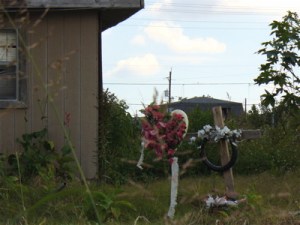
A front yard memorial in the Lower 9, representing the loss of a family member during Katrina.

It has been nearly 16 months since Hurricane Katrina crashed the party in New Orleans and managed to bring about a sound not heard there in almost 40 years – silence.  Bourbon Street and the renowned jazz clubs were closed for business.  Not since Hurricane Betsy in 1965 had a disaster caused such quiet in the Crescent City.

Although downgraded from a Category 5 to a Category 3 hurricane, Katrina still managed to pack sustained winds of 127 mph and a ruinous 27-foot storm surge.  Initially it appeared that New Orleans had narrowly avoided another disaster when Katrina weakened and veered east from a direct hit on the city center.  To some degree this was true, the damage resulting from the actual hurricane was minuscule compared to the events that began to transpire early Monday morning, August 29, 2005.

Shortly before dawn and continuing through late morning, catastrophic failures in the levee and canal systems led to the flooding of 80 percent of New Orleans.  Much of the city remained flooded for six weeks and roughly 120,000 properties were substantially damaged or destroyed.

Twenty hours before Katrina made landfall I was asleep in the parking lot of a Cracker Barrel restaurant somewhere in Mississippi.  I, along with my wife, Mïa, 32, an employee of the New Orleans Jazz & Heritage Festival, and our cat Jordan, had managed to escape from New Orleans, but we hadn’t slept in over a day.  After clearing the Louisiana border the anxiety and adrenaline wore off and fatigue consumed us.  We needed to shut down for a minute before driving any farther.

All week New Orleans residents knew a hurricane was in the Gulf.  What nobody realized until Saturday morning was that Katrina had veered west overnight and was now heading straight for the city.  When I first saw the storm track on CNN Saturday morning I just stared at it, trying to process the information.  There was no “cone of uncertainty.”  In 44 hours Katrina would be arriving.

As irony would have it, Saturday had been a beautiful day but the forecast for the next 72 hours continued to deteriorate.  Around 11:00 p.m., New Orleans Mayor C. Ray Nagin addressed the city and advised Orleans Parish residents to evacuate immediately.  He stopped short of issuing a mandatory evacuation, reportedly due to unresolved legal issues.  As if to put an exclamation mark on his statement he added that his family would be getting on a plane immediately after the press conference.  That was the tipping point for us.  It was time to get out-of-town.

Leaving was a lot easier said than done since we didn’t own a car.  We had only been living in New Orleans for 11 months, having relocated from Washington, D.C., and didn’t need a car until Katrina came calling.  Thankfully, I had the foresight to make a reservation with Hertz earlier in the day.  I grabbed a cab immediately after the mayor’s speech and headed out to the Armstrong International Airport location.  Waiting for me upon arrival was a line that stretched out into the parking lot.  Katrina would hit in less than 30 hours.

Because this hurricane had already hit Florida, it was expected to weaken and veer east.  When that didn’t happen it caught everyone off guard.  Business people, air travelers and residents were left scrambling to get out of the area.  Hertz, the only rental car agency open, had become the option of last resort for bewildered travelers who were being told to evacuate as soon as they exited their inbound flights.

Although the line didn’t move for the first hour and a half, people were still being congenial.  There was some pleasant chatter with a businessman from Indianapolis and comic relief provided by the still intoxicated members of a bachelor party from New Jersey.  It wasn’t until around 3:30 a.m. on Sunday, when staff began counting the number of people in line that things became tense.  Hertz was running out of cars.

Travelers had continued to walk over from the airport once they realized there would be no more outbound flights.  They came staggering out of the misty darkness with their bleary eyes and rolling suitcases, muttering something about cars.  This is when the enormity of the situation became obvious.  People started negotiating cab fares to Atlanta and Memphis.  Shortly before Hertz cut off the line the police arrived to maintain order.

At 5:30 a.m. I drove off the Hertz lot.  While I was gone my wife had packed and prepped our house – taping up our windows, because that’s what we always saw on the news, and moving our belongings into safer parts of the house.  We packed some clothes, financial records, the computer and some photographs, but there was no way to take everything we would like.  Besides, this was only supposed to be for a couple days.  We never anticipated being gone for over a month.

NOLA 2By 7:00 a.m. we were out the door, intending to head for my parents’ home in Kentucky.  Tired and stressed, we needed to get moving fast, traffic was backing-up all around the city and it could delay our exit for hours.  Katrina would not make landfall for twenty-three more hours, but her winds would arrive much sooner.

Even before Katrina, my wife and I had already begun to discuss how much longer we were planning to stay in New Orleans.  It was a wonderful town, full of mystery and culture, but the institutional failures ran deep, many lingering from the Civil War.  As a visitor they could be overlooked, but not as a resident.  After returning from the evacuation it became harder for me to shake the feeling that the other 49 states were weighing heavy upon Louisiana.  As we left, every mile north made that weight become a little lighter on my shoulders.

Initially we had no choice but to return to New Orleans.  Our home was there, and we needed to ascertain its condition.  Our third floor condominium was in a fortified turn of the century cotton mill, where a few residents had elected to stay and ride out the storm.  They had been posting blog updates on The Times-Picayune’s Web site so we knew the building had taken some damage.  Also, by checking “google earth” we could survey the surrounding area for damage.
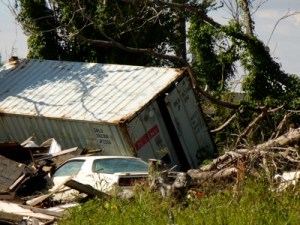
MessBy late September I had returned to Louisiana, but it was to Baton Rouge, not New Orleans.  My law firm, where I was a paralegal, had secured temporary office space and housing there.  Baton Rouge, which is only 80 miles northwest of New Orleans, had been completely inundated.  Its population increased by approximately 100,000 people overnight.  This massive influx of humanity had overwhelmed the city’s infrastructure.  Commute times increased exponentially, what used to take 15 minutes was now a two-hour odyssey.

I elected to try moving back down to New Orleans instead of staying in Baton Rouge.  Technically there were only day passes available for re-entry into the city, but it wasn’t being strictly enforced.  The power was still off and the water was questionable, but I could get by with candles and a cooler.

We were lucky, aside from the science experiment inside my refrigerator, our unit had taken no damage.  A tornado had lifted the roof from the penthouse units in the rear of our building and allowed enough water to pour inside to drench four floors of condominiums.  But overall the structure of the building remained sound.

NOLA 3I next turned my attention to the city’s condition.  I needed to see the damage with my own eyes.  I may have lived here but I watched Katrina unfold on CNN like everybody else. First, and most obvious, was the lack of people – it felt like being on the set of some post-apocalyptic movie.  Occasionally I would run into the military in their Humvees, but few civilians.  As darkness fell across the Crescent City the silence was palpable and the darkness absolute.

It took about a week for the power to return and by then I was about finished cleaning out my fridge.  A few more people had returned and there were rumors of old haunts having re-opened for business.  I started making runs into the downtown area and French Quarter after work to explore.  Discarded refrigerators, duct taped shut, littered the streets and their foul odor permeated the air.  With markings on the doors or walls of every house from first responders indicating whether people or pets had been found inside, this place resembled a massive crime scene.

I quickly learned to be vigilant while traversing the dark French Quarter streets.  It was decidedly unsettling to turn a corner suddenly and run into the military, with their night vision goggles and weapons drawn.  Johnny White’s, on Bourbon Street, was indeed open and had remained so throughout the entire storm, getting ice from the military to mix cocktails and keep the beer cold.

A little time passed and things stabilized in the central portion of the city.  I could again find a shrimp po-boy or crawfish etouffe, but the staples, like bread and milk, remained difficult to come by.  Residents in the wealthier Uptown and Garden District neighborhoods were able to repair damage to their homes rather quickly.  The French Quarter and Central Business District also were spared significant damage, but essentially all other sections of the city were severely compromised.  Price gouging became a norm.

The price to rent or purchase any available property increased astronomically.  Many of our friends who rented had been evicted for higher paying tenants, usually government contractors.  The other oddity was the absence of women and children in the city.  It wasn’t until 2006, four months later, that you started seeing kids again.

Dilapidated Mardi Gras floats left soaked in storage.

Dilapidated Mardi Gras floats left soaked in storage.

In February, after Mardi Gras, which had been scaled down for a local crowd, Jazz Fest became the big event.  My wife in particular felt that if Jazz Fest could be held it would be an important moment for the city.  Due to gracious artists like Bruce Springsteen, Bob Dylan, Elvis Costello, Jimmy Buffett and the Dave Matthews Band, along with a litany of dedicated local artists like Dr. John, the Meters and Irma Thomas, Jazz Fest was rewarded with record attendance figures.  This did turn out to be a landmark moment for the city because it showed the tourist industry that New Orleans was still a viable town.

Mïa and I had continued playing the “should we stay or should we go” game.  A personal and difficult toll to measure was being exacted upon residents living in the tattered ruins of New Orleans.  Due to the breadth of the storm’s damage it was impossible for people to get a break from the debris.
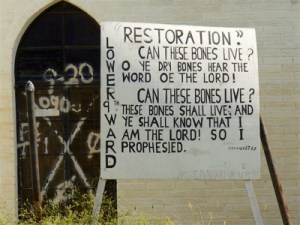
NOLA 4Unlike the 9/11 attacks in New York City, where citizens and emergency personnel could leave the scene and go home to unaffected neighborhoods, the damage in New Orleans was spread over one hundred and forty square miles, denying anyone the opportunity to look away.  Something as mundane as going to the grocery required venturing through the completely obliterated Lakeview neighborhood.  This blight might not consciously bother one every day, but it was always present in the back of your mind, casting a veil of darkness over everything else in life.

Finally, between the lack of any constructive rebuilding effort being mounted by the government and forecasts for an active upcoming hurricane season, we decided to move from New Orleans.  We were fortunate to have the option to leave on our own terms, while many others did not.  If another storm were to come, we might become hostages of the insurance companies, like so many others.

Today, approximately 240,000 former Orleans Parish residents remain displaced by Hurricanes Katrina and Rita.  Where are they?  Check in Houston, Memphis, Birmingham, or Atlanta, to name a few cities.  As for the 200,000 residents who have managed to return, around half still reside in FEMA trailers.  They are left to process what has happened and cope with the decay that now surrounds their lives.

NOLA 6

Only the mangled railing remained after the flood walls gave way across the street from this 9th Ward home in the darkness, sweeping this home, and many others – along with their inhabitants, away with the deadly current.

In the Lower 9th Ward, several blocks of homes ran parallel to the Industrial Canal, only a couple yards across the street from the flood wall.  It was barely past sunrise when two sections of this wall collapsed, unleashing a swollen tidal surge upon an unsuspecting neighborhood.  The water came through with such velocity it tore houses from their foundations and broke them into pieces as they bounced down the street.  People caught outside had the very clothes they were wearing torn from their bodies as the water rushed through.

New Orleans East and the Lower 9th Ward are now virtual wastelands, more like two sprawling, dilapidated cemeteries than the vibrant neighborhoods they once were. Makeshift memorials have been placed in overgrown yards to remember family members who failed to escape the rising water.  Little of the debris has been removed from these areas, which prevents former residents from even considering a return to rebuild.

NOLA 5To this day the landscape is crowded with homes that have been tossed atop each other.  It’s difficult to distinguish the individual houses amongst the rubble.  Cars and trucks protrude underneath piles of debris in awkward angles or are perched atop former residences.  It’s a decidedly un-American scene.  Particularly disturbing is all the personal belongings left exposed for the world to see; a child’s teddy bear, a headboard and box spring, tattered family photographs and a variety of other trinkets from so many broken lives.

For Katrina’s victims, the road home will be a difficult one.  Their immediate future has basically been taken from their grasp.  The ability for residents to return and rebuild depends in large part upon the tourist industry.  Businesses already are suffering under the strain of attempting to operate with 60 percent of the city’s residents absent.  Unless the various revenue streams from tourism can be re-established, it will be problematic for the city to return to anywhere near its previous size.

New Orleans relies on tourism dollars to fill the gaps between its large yearly events.  In turn, the service industry is a primary employer for its residents.  Due to the decreased amount of tourist traffic and the lack of available service industry help, many businesses remain closed or are only open reduced hours.  The equation is simple enough, but it requires investing in the future of New Orleans and its potential to again generate tourist related revenue.

BattlegroundThe government’s response to this call for investment is the Road Home program.  This, along with temporary housing aid from FEMA and low-interest SBA loans, are the resources available to Gulf Coast residents.  Although these programs may eventually be effective recovery tools, they have thus far proved restrictive, creating more questions than answers.

The Road Home program in particular is designed to help those residents in the hardest hit areas, but questions have been raised regarding the effort by the government to assist those populations with navigating the application process and completing the complex paper work or on-line applications.  Additionally, many of these same residents remain unable to travel home and most would lack access to a computer or the skills to operate one even if resources were in place for their return.

Still, the hardest decision facing Road Home applicants is should they rebuild, or should they relocate?  Applicants are unable to receive grant disbursements until this decision is made.  Since no governmental agency to date has produced a recovery plan, it is unknown whether certain neighborhoods will be designated as “green space,” and thus not rebuilt.

This essentially forces residents to gamble their available resources on returning to these blighted neighborhoods.  In the event that the government decides to later annex certain neighborhoods, these residents stand to lose everything all over again.

BearAt least the Road Home program has the potential to produce a positive outcome, whereas the insurance industry continues to play the villain in most people’s eyes.  On the heels of their unilateral denial to pay claims on homeowner policies involving water damage, there are now estimates that the insurance industry intends to raise homeowner policy rates somewhere between 30 and 150 percent.

This could be a fundamental stumbling block to the recovery of the Gulf Coast region.  If there is no affordable or available insurance for homeowners and businesses, then banks will be unable to loan any money, halting investment in the future of the New Orleans area.

Another major issue exacerbating an already difficult situation has been the faster-than- anticipated resurgence in crime around the metro area.  The Times-Picayune, on November 26, 2006, reported, “The number of violent crimes such as assault, robberies and murder rose 62 percent from the first quarter of the year to the second.  Nonviolent crime rose 22 percent during that same period.”  It’s going to be difficult convincing the tourist and business industries to risk a return to New Orleans if the rise in criminal activity cannot be stemmed.

The home of Fats Domino, located in the Lower 9, and where the rock-n-roll icon was trapped in a flooded attic in 90+ degree heat until being rescued after the storm.

The home of Fats Domino, located in the Lower 9, and where the rock-n-roll icon was trapped in a flooded attic in 90+ degree heat until being rescued after the storm.

The future of New Orleans and the Gulf Coast region is murky at best. Unless these interrelated problems with insurance, housing, jobs, crime and tourism, are resolved the road back to vibrancy in New Orleans will not be heavily traveled.  Sufficient resources are not going to be available to rebuild this entire city, so either through eminent domain or denial of insurance coverage, its footprint is likely to be decreased.

Some former residents are already finding a higher standard of living in other cities.  If the government fails to produce a decisive recovery plan quickly, people are going to move on with their lives in another city.  It would be unfortunate if the infamous “laissez-faire” attitude of New Orleans proves detrimental to its own recovery.

Although the challenges to this community are monumental, these are a resilient people, who are willing to fight to return home.  Make no mistake, there will be a New Orleans, it just depends on what shape it will take.  As for Mïa and I – nine months after returning from the evacuation – we steered our Budget truck out across the bayous and wetlands of Louisiana, leaving New Orleans in our rear view mirror for good this time.


Posted in Family, Food, Liquor, Literature, Music, News, Politics, Travel | Tagged , , , , , , , , , , , | Leave a comment