A few days of mild temperatures and snow flurries are upon us once again. The Farmers’ Almanac indicated this was going to be a severe winter and it was spot on correct.
Kentucky has been a solid blanket of snow since January, and we haven’t remotely been getting the worst of it this winter. That distinction belongs to the Midwest and New England. Both have been getting pounded continuously with record low temperatures and significant snow accumulation.
Meanwhile, California is experiencing its driest year since becoming a state in 1850. On average, the Golden State receives about 22 inches of rain normally over a year, one of the lowest averages in the U.S., but in 2013 only 7.38 inches fell. While several months of winter remain, the Sierra Nevada snow pack, which serves as a vital water source for the region, is at just 20 percent of its average accumulation.
The result is being termed a mega-drought. Across California, there are 17 communities that have been identified as potentially running out of water altogether over the next two to four months. A drought emergency has been called by California Gov. Jerry Brown, and residents have been asked to reduce water usage by 20 percent.
It’s beginning to become apparent that these sorts of abnormalities are the new normal. The biggest problem is people don’t want to take personal responsibility for the environment.
“This is not an if, it’s now,” said Dr. Diana Horton, Professor Emeritus, Dept. of Biology at the University of Iowa, about the reality of climate change impacting the here and now.
“North Americans are a horribly spoiled bunch,” said Dr. Horton. “We must make sacrifices…now.”
Life is busy these days. The Internet Age has only accelerated the global pace of life. Between family and work, precious little time is left over to contemplate something as big picture as climate change.
This leaves us all in a holding pattern, waiting for something more destructive to come along that will be impossible to overlook. Minus that catastrophic event people refuse to change their ways much.
We’ve already seen very unusual and unpredictable weather, and specialists in the field believe that an extreme intensification in all weather-related events is anticipated going forward.
“Katrina was like the first bombing of the World Trade Center (02-26-93), a wake up call, but people are snoozing,” said Dr. Horton. “Ramp this up and what if people have to leave coastal areas?”
Estimates look at potentially having to move three-fourths of the world’s population if the melting of ice caps can’t be held in abeyance. And that is if they can even be controlled by human action to remain frozen at this point.
There is no exact date that something is going to happen, but it has already begun, and changes are metastasizing faster than anticipated.
The Intergovernmental Panel on Climate Change released its Fifth Assessment Report on September 27, 2013, offering incontrovertible evidence that burning fossil fuels is the cause of most of the temperature increases of recent decades, and warn that sea levels could rise by almost three feet by the end of the century if we don’t change our ways.
While the U.S. population as a whole is moving toward the reality of climate change, Congress remains like a deer caught in headlights. These are not stupid people, but they must run for re-election, and that is expensive, so without the urgency of public insistence, they technically are remaining loyal to their financial benefactors who make money off polluting and keeping things the way they are.
Almost one-third of the 535 members of the House and Senate are on record as climate deniers, according to a recent study by the Center for American Progress. Coincidentally, those 161 reps have taken more than $54 million in political contributions from the fossil-fuel industry.
Token concessions, like hybrid cars, are just lip service to make us feel better and appear more conscious. Coal driven electricity is just as bad as gas, and is a horrific polluter of Greenhouse gases.
Hybrids only allow us to mask the true problem, more people need to drive less.
In places like Iowa, which many consider is only suited to fly over on the way to other destinations, in reality is a key state in maintaining the country’s food chain. The Hawkeye State has a fragile eco-environment, where even a slight temperature change could render the rich topsoil unable to grow crops or allow livestock to be sustained.
The other scenario that could play out in the Midwest is that coastal regions of North America begin evacuating due to rising sea levels, and states that previously were full of expansive farmland, like Iowa, will become destination locations.
None of these states have the infrastructure to support such a migration.
One thing that is known for sure is that the adjustments surrounding less available fossil fuels will pale in comparison to what will occur when fresh drinking water becomes scarce.
Wars might be fought over the remaining fossil fuel reserves, or because countries like China and India refuse to decrease their pollution emissions, but global conflict will certainly be waged over access to clean drinking water, because without water life stops.
In all likelihood it will require legislation to force people to comply with energy conservation levels necessary to make a difference, but that takes leadership, and the U.S. political structure remains bought and sold by big business and Wall Street.
Admittedly changing old habits of energy consumption is no small undertaking. It will impact everyone, and change the way lives are lived, but we all have a responsibility to this planet. Better to start making these changes now, before some global disaster impacts the country and forces them all at once.
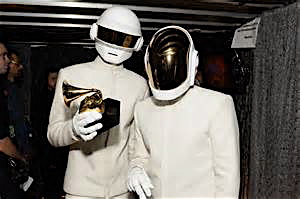
The robots of Daft Punk showing off one of their multiple Grammy’s from Sunday.
The 56th annual Grammy Awards will most be remembered for headgear, from Pharrell William’s oversized chapeaus to Daft Punk’s robot helmets.
We saw Pharrell a lot this evening, as he was the common denominator in two summer smash hits, “Blurred Lines” by Robin Thicke and “Get Lucky” by Daft Punk, so his rumpled Canadian Mounted Police hat was on wide display.
The telecast wasted no time moving into the dominant themes of the evening.
Katie Perry and Lady GaGa both had big hits, but it was newcomer Lorde who proved to be the Queen Bee with her song “Royals.” The earlier performance of this song should have tipped viewers that her night was going to keep going up. It was confident and impressive, without all the unnecessary contrivances most pairings included throughout the evening.
The 17-year old from New Zealand took home one of the night’s biggest wins for Song of the Year and maybe even more surprising, Best Pop Solo Performance.
The night’s first televised award went to rapper Macklemore and his producer/DJ Ryan Lewis for Best New Artist. This pair has been on a meteoric rise since 2012 when “The Heist” was released. “Thrift Shop,” “Can’t Hold Us,” “White Walls,” and “Same Love,” have earned this duo a string of sold out arena shows since.
“Thrift Shop won for Best Rap Song and Best Rap Performance. Their album “The Heist” scored Best Rap Album, beating out Jay-Z, Drake, Kendrick Lamar, and Kanye West.
But the night belonged to the machines.
Wearing tuxedos and their trademark robot helmets, Daft Punk set the tone early when “Get Lucky” won for Record of the Year, beating out the likes of “Radioactive” by Imagine Dragons, “Royals” by Lorde, “Locked Out of Heaven” by Bruno Mars, and “Blurred Lines” by Robin Thicke.
They also took Best Pop Duo/Group Performance.
The two Frenchmen stayed in robot character all evening, never speaking, switching from black tuxes and Gold helmets, to all white – it didn’t matter, Daft Punk won everything in their path.
Their album “Random Access Memories” scored Best Dance/Electronica Album, Best Engineered Album, and then took the big prize for Album of the Year.
What sets this track apart from other hit songs like “Thrift Shop” or “Blurred Lines” is no video is necessary to enhance its listenability. This tune ignites naturally with the driving guitar line, courtesy of Nile Rodgers, the co-founder of Chic.
Just to seal the deal Daft Punk blew out “Get Lucky” at the Grammy’s with their friends and Stevie Wonder. The entire arena was up dancing, which is the only instance when that occurred all night.
Interestingly, Robin Thicke’s “Blurred Lines” essentially got shut out, mainly because it was so heavily tied to the clean and boobalicious versions of the video.
I thought the pairing of Imagine Dragons with Kendrick Lamar worked well, as they ripped “Radioactive,” which took home the Best Rock Performance.
It was surprising to see Metallica bomb so huge. Taylor Swift not so much.
Speaking of sucking, the other major theme of the night was the ridiculous number of senior citizens that performed and somehow were nominated for awards.
I don’t get Paul McCartney taking home the Best Rock Song, even if the surviving members of Nirvana were involved. That the Rolling Stones and Black Sabbath were also nominated is tragic. Gary Clark Jr. is killing it, and “Panic Station” by Muse is an incredible tune. Either should have won.
Ringo Starr and Paul McCartney both gave morbid performances. There was a dreadful medley from Willie Nelson, Kris Kristofferson and Merle Haggard, who brought along Blake Shelton to keep the wheels from completely falling off.
Then I saw the “supposed” Best Rock Album category – I’m sorry but is it 2014 or 1975?
The nominees were: “Psychedelic Pill” by Neil Young & Crazy Horse; “The Next Day” by David Bowie; “13” by Black Sabbath; “Celebration Day” by Led Zeppelin; “Mechanical Bull” by Kings of Leon; and “…Like Clockwork” by Queens of the Stone Age.
Once again we have two artists that are current and the rest well past their prime. How did a Springsteen album not somehow wiggle into the mix?
Amazingly Led Zeppelin won this award. They don’t even have their original lineup on this recording. Bonham’s kid is on drums. It was a reunion the band did as part of a tribute show in 2007 for Christ sake!
I like this disc and grew up listening to Led Zeppelin, but it has no business winning anything. The Queens of the Stone Age recording was a number one record, and they have legitimately become the psychedelic troubadours of desert stoner music.
Overall this was an extremely uneven night, filled with mediocre music and contrived performances. This happens all the time on awards shows, but this year the underlying product was weaker than most. Even though Daft Punk carried the day, this isn’t by any means their best work.
The Grammy’s notoriously snub the rightful artists when they are creating their best work, and here was a vibrant chance for the recording academy to make up for past mistakes and give Daft Punk some well-deserved recognition.
There continues to be a shift in the musical landscape, as rap, rock, electronica and indie moping combine with Americana roots. Where this is going remains unclear. There is a decided darkness in this current generation, which is not surprising, but they have managed few artists of note thus far. It’s mainly riffs on performers and genres that have come before them.
The ice formations along Devils Hollow in Frankfort, KY.
With the unwelcomed return of these body-numbing temperatures, it can seem ironic to discuss the idea of global warming, considering the lack of warmth available.
I suppose that is part of the point. Anymore, rarely are there normal weather patterns. It doesn’t get just a little cold; we get a polar vortex, where temps drop over 50 degrees in under 24 hours. Subfreezing temperatures are accompanied by -50 wind chills and four feet of snow.
Rain is the same way. Light sprinkles are a thing of the past. Instead the skies open and torrential downpours saturate areas causing flash flooding, like we saw in Colorado this past September. In a matter of three days 17 inches fell, exceeding the yearly total for the state. At least eight people died as a direct result, and damages went above $2 billion.
Temperatures don’t get a little hot; they set records and cause droughts, such as in 2012. During the peak heat in July, 81 percent of the U.S. was at least abnormally dry, costing more than $35 billion in losses for the Midwest, and a drop in the gross domestic product for America, equating to a loss of $75 to $150 billion.
A tornado doesn’t touch down and cause a bit of damage. Several funnels descend like grim reapers in the dark of night and wipe unsuspecting towns off the map. On Nov. 18, 2013, 16 tornadoes ripped through Illinois and Indiana.
Wildfires, sinkholes, mudslides, typhoons, earthquakes – they only come super-sized these days.
A common scene in the Lower 9th Ward of New Orleans after Hurricane Katrina.
Previously, storms like Sandy or Katrina were considered at least 100-year events. Now they occur on a yearly basis.
It begins to feel like our planet is fighting back, against the overpopulation, commercialism, deforestation, and marginalizing of various animal populations.
The land ends up getting raped of its natural resources and we turn a blind eye to the crime, and the improper waste disposal, so we can get a cheaper commodity.
It’s easy to get caught up in the rapid pace of modern life and assume others have the job of making sure that how our food and energy arrive to us is taken care of in a responsible fashion.
Yet we are our own global guardians. Political will is often bought and sold. It takes big money to run for office, and there is a lot of wealth surrounding the procurement of energy and private enterprise – so don’t look for those stakeholders to do the right thing. They are only in this to maximize profits in the short run.
The beach cleanup effort in Grand Isle, LA during the BP spill.
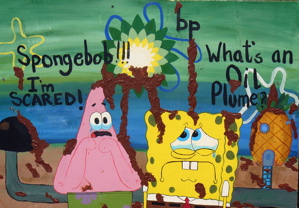
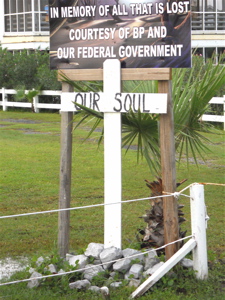
They will cut corners, pollute our waters, and risk lives to make more cash. Look at how irresponsible the general business practices of BP were as they extracted oil off the shores of Louisiana in the Gulf of Mexico prior to the Deepwater Horizon oil spill in 2010.
After the explosion on the oil rig and its sinking, oil gushed from the sea floor for 87 days, discharging an estimated 4.9 million barrels into the water, impacting 68,000 square miles of ocean. That is equivalent to the size of Oklahoma. The spill killed marine life at record levels, permanently damaged fragile ecosystems and changed the way of life in that part of the country.
Eleven employees were killed in the blast. Their bodies were never recovered. BP pled guilty to 11 felony counts related to their deaths, including manslaughter, obstruction of justice, obstructing Congress and lying to federal investigators.
Prior to the blast it was shown BP supervisors knew they were operating the well dangerously and they kept doing it anyway in order to hit production marks. The possibility that investigators might catch up with their violations were of little concern.
It’s not like the Deepwater Horizon is the only well rig, coalmine or other regulated facility that voluntarily chooses to operate under dangerous conditions. It just happened that the explosion occurred; otherwise they would have kept right on doing what they were doing.
State and federal budgets continue to get trimmed in the post-recession. There is less oversight available to adequately inspect all the equipment and production practices undertaken by commercial ventures. Instead many choose to run afoul of the law and risk fines because it’s impossible for our government, much less those in foreign countries, to sufficiently keep them under watch.
These supposed “business leaders” act like spoiled children getting over on their absent parents. They know the watchful eye is lax and take advantage of the situation instead of doing what is ethically right, what is best for the planet, or what is best for its inhabitants, all for G-R-E-E-D.
It’s true the rest of us working stiffs are always looking for bargains. Money is tight, and higher prices on plastics, food and fuels are a delicate balance. We all witnessed what happened in America when fuel prices went above $5 per gallon. The system buckled, as commuters could not handle the expense. People are living paycheck by paycheck more than ever before, most with little to no savings, so cheap is considered good.
This is where leadership is required. Don’t artificially bring down costs of essential products. That just prolongs peoples’ poor behavior.
Trust me, you piss this planet off bad enough it will come through with a global climate change that will wipe away the human slate as we know it. We’ve pissed away so much of our time and resources into pork barrel projects and decreased energy costs, that our infrastructure, power grids, and education systems have been left in shambles.
Prolonged extreme heat or cold could change our privileged and frivolous lifestyles in the snap of a finger. Rising sea water around the east, west and southern borders of the United States will cause an inward migration toward safety, and quickly developing water shortages in other parts of the world, but also in the western portion of the United States, are the kinds of things wars are fought over.
These hard truths require personal responsibility and sacrifice to address. The United States continues to be a reactionary populace. It generally takes a trigger event to finally get people to truly pay attention.
After-effects from Hurricane Katrina and Superstorm Sandy continue to be felt around America. Unfortunately those types of devastation can no longer be overlooked as isolated regional events. Climate change and natural disaster come in many colors, and death has been laying its cards on the table all across the country.
Similar devastation can come calling anywhere these days, and city planners, political officials and emergency management acknowledge this fact, but they continue to mostly plan how to react after tragedy strikes. What nobody has the courage to address is what we as a responsible population should be doing NOW to help prevent the next disaster.
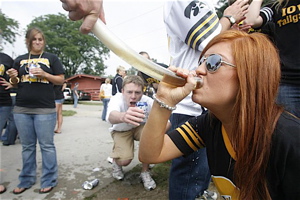
Nothing like a beer bong to get your tailgating off to a fast start. (AP photo courtesy of Matthew Holst / Iowa City Press-Citizen)
As the adage goes, if you work hard enough at something success will follow – even if that something is partying. In Iowa City, Iowa, happy hour is a prospect that is taken very seriously, and for that reason Princeton Review has named the University of Iowa the No. 1 party school for 2014 in its annual Top 20 list.
Iowa has been hovering around the No. 1 spot for several years now, securing second place in 2013, and No. 4 in 2012, but the tradition of party excellence in Iowa City dates back to the early 1960s, when the campus was a counter-culture hot spot.
Iowa continues to have an interesting mix of crunchy hippies, Magnificent Mile fashionistas, and inked-up indie kids that coexist in the land of The Hawkeye.
The bridging mechanism between all these various demographics is the party scene. Spilling out across the street from Iowa’s downtown campus are 70 bars and restaurants.
There also is plenty to like about the live music scene in Iowa City, as the campus is located about four hours from Chicago, Milwaukee, Minneapolis, St. Louis, and Kansas City, which attracts plenty of touring acts, in addition to the fine local talent.
Still, Iowa football remains the big dog on campus. Kinnick Stadium is a mile walk from downtown, which most folks make carrying a beverage. The area around the stadium becomes a sea of Black & Gold, as young and old partake in all manner of drink and grub leading up to kickoff.
This fun and frills combination serves to draw a rambunctious mix of students, from Iowa and surrounding states, particularly from the greater Chicago-land area, adding urban fuel to the party scene.
University of Iowa officials continue to try and downplay the top party ranking, as they attempt to get a grip on the problem of underage and binge drinking.
A recent ordinance raised the age from 19 to 21 for those allowed to stay in the bars after 10:00 p.m., and prohibited drink specials like “Ladies Night,” where women could drink all evening for $1. Police have also cracked down on open container laws during tailgating, which hasn’t been received well by alumni.
Yet true improvement has been slow to materialize.
I served as the court clerk for weekend lockups at the district court in Iowa City from 2007 to 2009, and the number of drinking-related citations and arrests surrounding home football games were routinely in the hundreds.
The stench of alcohol from defendants in the satellite courtroom, located in a nondescript space on the second floor inside the jail, was overpowering some mornings. A sea of red, watery eyes stared back at me, some looking down and shaking their heads in shame.
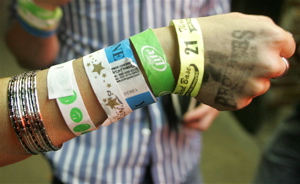
As each defendant stepped forward most shared a similar fashion accessory – multiple hand stamps and wrist bracelets from admissions to numerous bars.
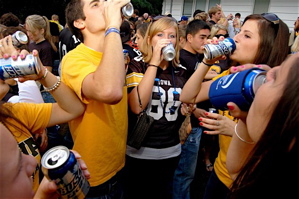
Iowa students showing their rowdy spirit at a home football game. (AP photo courtesy of Charlie Neibergall)
Binge drinking is big at Iowa. Beer bongs, beer pong, Jägerbombs – high octane alcohol is served in a pleasantly ingestible format so it may be swilled down faster, or is part of a game to ensure steady consumption and rapid intoxication.
This creates a target-rich environment for police. They record high arrests by picking off the low hanging fruit – those that are so drunk they perform some epically stupid public act for all to see.
After drinking themselves to the point of oblivion, the folks showing up in court have little to no idea what they did to get arrested. Their bodies had become mere vessels, marching around on autopilot, operating purely on the whims of impaired judgement.
One young woman arrested on public intox charges had a breathalyzer reading of .26, over three times the legal limit. At 5’5″ and 125 pounds this was especially crippling.
The police report stated she saw a car running on the street downtown by the Sports Column, a bar popular with fraternities and college athletes. In her inebriated state she felt a compulsion to reunite the vehicle with its missing owner, but needed to find out who owned the car, so she opened the passenger side door and got inside.
Unfortunately the vehicle happened to be a police cruiser. As she attempted to radio the dispatcher to inquire about the vehicle’s owner, officers came running. That was the end of her evening.
Another night police witnessed a student hiding behind a pillar in a parking garage, pants unzipped, boxers exposed, who then staggered into the street, clearly attempting to urinate in public, but incapable of handling such a maneuver. He blew a .30 – quite an impressive level of intoxication.
Then there was the young man who was jacked on controlled substances, and thought it was a good idea to start burning plastic beads at the Kum ‘N’ Go gas station. He was charged with Reckless Use of Fire/Explosives.
Once at the jail, we had to convince him he was granted an audience with the “Great One” in order to get him to put some clothes back on and behave so he would come out of his cell and appear before the magistrate. Placing his hands together in a praying motion, the kid bowed to the judge, and spent the rest of the proceeding rocking back and forth in his chair.
These kinds of stories go down every night in Iowa City. Kids drink themselves into a state where they no longer have the sense God gave an acorn.
Even after reading descriptions of the incidents leading to their arrests, most have no recollection of their behavior. Some audibly laugh and turn to other defendants in the courtroom to share their exploits, which does not go down well with the judge.
Some of this sounds humorous on the surface, and it is, until you see the sheer volume and repetition.
There also is a much darker side to the level of drinking and drug consumption that commonly occurs at Iowa.
(Photo courtesy of Facebook)
It’s not odd to see a guy running down Iowa Avenue, past the bars and into the adjacent off-campus neighborhood, with a drunken woman draped across his shoulder. They’re heading for a house party most likely, and she is laughing, but what are her chances of being able to make a coherent decision on sleeping with that guy or several more that same evening, or of even being able to say the word NO.
Routinely friends come to visit students at Iowa, and they end up getting blasted out of their heads at the bars.
Ultimately they get separated from their friends during the alcohol-filled festivities and come stumbling back at 2:00 a.m., to try and find their friends’ houses, but can’t quite pinpoint the exact one.
Then a home invasion occurs.
A wasted kid kicks the door open or throws a porch chair through a window and enters the house he believes to be his friend’s. Problem is he entered the wrong home. Confusion sets in and the perpetrator wants to fight the legal resident, who has been surprisingly awakened.
In a bigger city this would get the perpetrator shot. In Iowa City it usually ends with an arrest for trespassing, assault, and public intox. Though it has resulted in at least one murder.
The twisted part about all this is for decades administrators at the University of Iowa have consciously elected not to address the alcohol or controlled substances abuse by its students, which in my book makes them complicit.
Colleges are big businesses, and smart business practices dictate that administrators protect their products.
At Iowa part of that product is the school’s reputation. It is ranked as one of the top public universities in the county, and offers a superior education at a great value in terms of tuition costs.
The University of Iowa Hospitals and Clinics, along with the law, journalism and business schools, are all cutting edge, and Iowa is home to the Iowa Writers’ Workshop – the premier graduate writing program in America.
This part of the Iowa business model sells itself, but all the Big 10 schools are solid academic institutions, so much like how Iowa has to work diligently to recruit top-level athletes, it also has to be creative in how it fills its freshman classes.
Each out-of-state student pays three times the tuition of any single in-state resident, and administrative bean-counters love landing them.
A good night drinking – Iowa City style. (AP photo courtesy of Dan Williamson / Iowa City Press-Citizen)
Make no mistake, Iowa’s party reputation serves as a national advertisement for kids seeking a good education and wanting to have a fun time getting it.
Earning Princeton Review’s No. 1 party ranking is priceless in terms of the free publicity it provides.
The university would never publicly condone the party-culture at Iowa, but it also did little for years to decrease its escalation.
It took arrest and citation numbers so obnoxious that Iowa City became a national example of underage drinking excess, along with some human casualties, before Iowa and city officials stepped in – as that highly valued academic reputation began to get tarnished.
It’s also important to consider the large amount of city revenue generated by the fines and other assorted expenses associated with the drinking and drug culture at the University of Iowa.
If police officers walk into a downtown bar, which they do often in Iowa City, and find an underage student drinking or in direct proximity of an alcoholic beverage, he or she will be cited for a PAULA (Possession of Alcohol under the Legal Age).
A first offense is $314. That’s $200 for the fine, a 32 percent “surcharge,” and $50 court costs. A second offense is a whopping $710, plus the defendant is required to obtain a substance abuse evaluation or lose their license to drive for thirty days.
A common trifecta would be getting hit with the PAULA, plus public intox and disorderly conduct. I liked to call that “Hitting for the Cycle.”
As the bars close in IC, the pedestrian mall fills nightly. (AP photo courtesy of Dan Williamson / Iowa City Press-Citizen)
Public intox and disorderly conduct are both simple misdemeanors, but you are going to jail. These are punishable by up to 30 days incarceration, and incur fines of between $65-$625 each, or a combination of both.
A student hitting for The Cycle could be facing over $1,500 in fines.
That’s no joke to a college student.
I’m all about personal responsibility. You do the crime, deal with the consequences. I don’t want to hear crying about what mommy and daddy are going to do to you.
On the other hand I want the university to step up and be a more responsible role model. Parents are sending their children to Iowa with the expectation that the university is looking out for students’ best interests.
That hasn’t always been the case.
* * * * *
[TOP 20 Party Schools: #1 University of Iowa; #2 Cal-Santa Barbara; #3 University of Illinois; #4 West Virginia University; #5 Syracuse University; #6 University of Florida; #7 Ohio University; #8 University of Wisconsin; #9 Penn State; #10 Lehigh; #11 University of Georgia; #12 Florida State University; #13 DePauw University; #14 University of Mississippi; #15 University of Texas; #16 Miami University of Ohio; #17 University of Maryland; #18 Tulane University; #19 University of Vermont; #20 University of Oregon]
IC NITEHAWKS: I built this “extremely basic” website in 2008 for a project in my journalism Web Basics class, but it turned into a functional tool for students to find the best drink specials in Iowa City on a nightly basis.
In Gov. Steve Beshear’s State of the State address Tuesday, education was a major theme, as budget cuts threaten to damage recent improvements in K-12 test scores and graduation rates.
Without a budget infusion teacher layoffs are inevitable, leading to significant increases in class sizes.
“We’re in danger of losing all of the positive momentum which has been built up, and I am not going to let that happen,” said Gov. Beshear.
Kentucky continues to try and emerge from behind its shadow of being a redneck backwater. Its success with the implementation of the Affordable Care Act, balancing its budget, creating jobs and continued educational improvements, are all helping to elevate the Commonwealth’s reputation.
No doubt The Bluegrass is a red state, but voting Republican doesn’t mean you have to be a knuckle dragger. This is a conservative state, with a high level of poverty. To compete in a global economy Kentucky must move past the rhetoric spewed by Tea Party loyalists and embrace progressive ideology.
Toyota is a big employer in Kentucky, but they have a hard time filling positions here. It takes a ridiculous number of interviews for management to find a single prospect with the basic education and skills capable of being a productive employee within Toyota’s modern work environment.
Historically Kentucky hindered its future generations by failing to make education a state priority, and handicapped educators by neglecting to adequately fund K-12 institutions.
Last year Kentucky took a step forward into the light by revamping science content in grades K-12. Teachings on evolution will now coincide with the latest research. The Next Generation Science Standards also addressed climate change, so discussions specify an explicit link between human conduct and its impact on the climate.
It’s not like Kentucky is out there alone in this thinking. These new standards were developed over two years through a consortium of 25 other states, and included input from educators and scientists from across the country.
In fact this is the result of a Republican-backed piece of legislation from 2009, which called on state educators to better align coursework with other states and improve comparability with national and international benchmarks.
Many would think this is no big deal, that of course these concepts are being taught to students because they are factually accurate, but in Kentucky, these are not ideas necessarily considered self-evident.
Creationists openly ridiculed these new standards as “fascist” and “atheistic. There was even talk about how this type of thinking would lead to “genocide” and “murder.”
It’s quite the opposite. These 21st century concepts are vital for Kentucky to keep pace with other states and better prepare students to enter college.
It’s discouraging to hear adults angrily argue that teachings on evolution and climate change are somehow similar to Soviet-style communism.
Embracing this kind of regressive thinking is precisely what creates the misperception that all of Kentucky is backwards.
There is nothing wrong with religious freedom, but like religious beliefs, keep it to yourself and don’t hold others back with frightened biblical misinterpretations.
Kentucky needs job development, and to get that our next generation of students must have the educational opportunities available to them to be competitive on a global scale.
Today was my first day back at work after a few well deserved days off during the week of New Year’s, but could we have just a regular first Monday back…? Hell no! It’s got to be some -22 wind chill, no snow on the ground, all the schools out, but grownups got to go to work kind of Monday.
So much for easing back into the work routine. I guess ripping the band-aid off in sub-zero temps is one way go. It does make you think a bit less about what the work day might entail and consider surviving the commute across town, just in case my car decided to keel over.
I was up early this morning to catch some news and check on closings, and I see this vortex thing has pushed a spike of arctic chill from N. Dakota all the way down to Hotlanta. It created a 140 degree difference in temperatures within the continental U.S., between the -55 degrees in N. Dakota and the 85 degrees in S. Florida.
That is insane.
It was like 5 degrees in Frankfort this morning, with a -20 wind chill factor. That’s a 50 degree temperature drop from yesterday here. I know it could be worse. I used to live in Iowa. They had double-digit negative temps all of today; Chicago set a record low of -16; and in Minneapolis, it’s -17, but feels like -40.
That’s why I didn’t move there.
Still, I’m sitting here watching Auburn play Florida State for the national championship in balmy Pasadena, and it’s -3 out my window.
A new snow has fallen and it feels like it’s -22.
That’s a lot more like Iowa than Kentucky.
It’s all good. Monday is over. I got my work swerve back, and I’m keeping a constant 75 degrees in front of this space heater.
Phil Everly (left), and brother Don, of the Everly Brothers.
Phil Everly, of the Everly Brothers, died Friday in Burbank, Calif. He was 74.
Phil, and his brother Don, provided the most lush and compelling harmonies in early rock-n-roll. There is a reason the Beatles, Beach Boys and Byrds all credited them with being huge influences.
Their parents were folk and country musicians from Kentucky, and the Everly Brothers were well acquainted with those genres, but they put a distinctive spin of their own on their music that earned them a recording contract in Nashville in the 1950s.
The brothers charted nearly three dozen hits on the “Billboard Hot 100” between the late 1950s and early 1960s; Bye Bye Love, Wake Up Little Susie, and When Will I Be Loved, to name a few.
Artists like Bob Dylan, Crosby Stills Nash & Young, and Simon and Garfunkel, are all indebted to what the Everly Brothers did in merging traditional harmonies with early rock-n-roll edginess.
My favorite tune of theirs is Cathy’s Clown, with its snide darkness that taints the surface sheen.
These guys came at rock-n-roll from a different direction, and were their own originals.
If you think about a table with the originators of rock-n-roll, most certainly it would include the likes of Chuck Berry, Fats Domino, Elvis, Buddy Holly, Jerry Lee Lewis, Little Richard, and Muddy Waters, but the Everly Brothers would be given serious consideration for an invitation.
They were one of the first 10 acts elected to the Rock-N-Roll Hall of Fame in the inaugural class of 1986.
Pitching health care in Barbourville, at the Daniel Boone Festival.
As 2013 comes to a conclusion and a new year emerges, there’s more than midnight kisses and champagne toasts to celebrate this time around – 2014 also brings with it access to affordable health care coverage for thousands of Kentuckians for the first time.
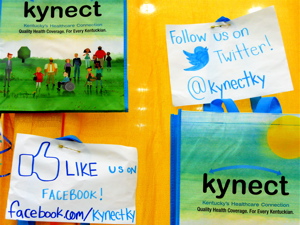
kynect, the online marketplace run by the Kentucky Health Benefit Exchange, has been up and running since October 1.
Coming into the Thanksgiving holiday, on average 1,000 citizens per day were enrolling in health care coverage. From Thanksgiving going into the Christmas holiday that number doubled to 2,000 per day. And on December 23, the deadline for individuals to guarantee coverage to begin on New Year’s Day, 4,000 applications were processed.
As of Monday, over 115,000 Kentuckians have new health care coverage – and there are three more months of open enrollment to go.
While kynect has not had the same level of technical difficulties experienced by the federal website, healthcare.gov, it has produced its fair share of glitches and surprises.
Yet lost amid the political scream-fest between conservatives and Democrats over the merits of Obamacare, is the ambitious challenge undertaken by those responsible for providing a functional plan to provide health care to the majority of uninsured Americans, and that it was able to be implemented across 50 states.
Talk about a gleam of hope.
I have worked with one client for going on two months now to get her application straightened out. She is homeless and has severe health issues that have rendered her only able to earn sporadic income from odd jobs.
Is she pleased about her circumstance? No. But she is fighting to get the help she needs, and that help was not available previously.
This woman has waited for four months to get an appointment for some critical tests in Lexington. If she didn’t have insurance coverage in place by the first week of January she would have to wait another four months until an appointment perhaps became available.
Without a revenue stream in place, it’s possible the tests she needs might not have been made available to a person in her situation without the advent of the Affordable Care Act.
That is a health hazard many in America are fortunate enough never to have to encounter.
Critics of the Affordable Care Act (ACA) want to casually shrug off this social aid program as only providing free health care to those that don’t want to work.
That is simply inaccurate.
The ACA does help find coverage for those with little or no means, but it also offers comprehensive health plans to families making a respectable wage, to also minimum wage workers, and to older Americans hoping to retire, but have not yet reached Medicare eligibility.
These folks are currently hostages to employer sponsored plans and must continue to work because they have pre-existing conditions. They would either be denied coverage from insurers before the Affordable Care Act came along, or charged exorbitant premiums.
As Gov. Steve Beshear has tirelessly pointed out, these people without insurance are not aliens from another planet. They are our neighbors in many cases. They shop at the same grocery stores as you and me, and we all sit together in the stands on Friday and Saturday nights watching our kids play sports, and attend the same churches.
Often they are our family members.
I could not be more proud of Gov. Beshear and his staff for what they have done in making the availability of affordable health care coverage a reality in Kentucky.
And as Hillary Clinton so accurately pointed out, “It Takes A Village,” and that is what has allowed kynect to succeed in Kentucky.
There is the determination and professionalism being exhibited by the staff at the Kentucky Health Benefit Exchange (KHBE), along with members of the Cabinet for Health and Family Services, that refuses to allow there to be any wrong door for Kentuckians to approach when having questions about their health care applications.
Certified insurance agents and trained kynectors are in all 120 counties assisting people with completing their applications.
There is technical support from Deloitte, who built the portal through which applications are processed on kynect.ky.gov, along with CGI.
It can take weeks to get peoples’ applications freed up for completion depending on the severity of the glitch discovered.
Lists are kept of loopers, superloopers, super-dooper-loopers and flippers. It sounds like something out of a Dr. Seuss tale, and often it feels like “Who-ville” in the kynect Command Center.
Enough can not be said for the expert assistance Deloitte’s team has provided KHBE staff in troubleshooting the technical reasons behind why peoples’ applications have not gone as expected.
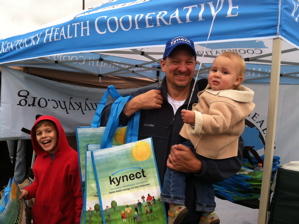
Jacy and Isabella help me hand out tote bags at Court Days in Mt. Sterling.
There also is Xerox, who has been instrumental in addressing the questions that come from the public and other invested professionals through the kynect call center. Customer service representative have fielded well over 100,000 calls to this point.
In the end all the political upheaval can be cut through with one simple question. Do you or someone you know currently NOT have health insurance? If that is the case, take a look at kynect.ky.gov, I think you’ll like what you find. It’s possible you, a friend or a family member might qualify for free or discounted health insurance coverage.
This past October 29 marked the one-year anniversary of Superstorm Sandy, the largest Atlantic hurricane on record. Though only a Category 1 when it came ashore, its winds spanned 1,100 miles and brought with it a 14-foot storm surge that devastated coastal communities in the northeast United States.
Sandy was the second most costly hurricane in U.S. history, with damages over $68 billion, trailing only Katrina’s $108 billion.
And there was the human toll, 286 people killed in seven countries, 72 in the U.S.
This massive storm stretched from Maine to Florida, and reached as far inland as Wisconsin, causing heavy rain and snow.
There always is a lot of talk by government officials, politicians and environmentalists after a disaster like Sandy, as they try to decide how to prevent a similar circumstance from occurring again.
This thoughtful approach is all well and good, but in the meantime there are families sitting outside their gutted homes with nowhere to sleep.
For individuals in these circumstances, there is no moving on from Superstorm Sandy, or a return to normalcy, until they can figure out where to live.
Do you rebuild or move away?
I lived in New Orleans when Hurricane Katrina came knocking, and once all the water receded, it came down to the insurance companies didn’t want to pay. And trust me, they will find a way not to pay. If you had homeowner’s, then they tell you that you should have known you lived in a flood zone and needed additional insurance.
If you had flood insurance, then the damage was caused by wind and rain. They always find an out, and they will take you and your tattered family to court with their sea of lawyers and tell you sorry, we don’t have to pay on this claim.
What ends up happening is folks can’t afford to move away. If the insurance companies or other government programs don’t pay out, then no one has the cash to walk away and start new, especially in this economy.
They become a hostage to a plot of land. But it is their plot of land. Maybe this is where they grew up. Maybe their whole family grew up in that house or in the neighborhood.
There is no other place these Sandy survivors can call home other than where they currently live.
Could these disasters be avoided? Absolutely. In every occurrence, generally the worst hit areas are places that never should have been developed in the first place.
Greedy developers swoop in to build lower cost, blue-collar neighborhoods, in less safe areas, and for whatever reason the zoning and permit boards allow this.
Breezy Point, NJ sounds an awful lot like the Ninth Ward neighborhood in New Orleans. It is full of close-knit families, many who owned their homes, not very affluent, but full of people who work hard to provide for their families and contribute to their cities’ character.
Ultimately, officials know they can’t protect these areas, and they shouldn’t have been built upon to start with.
Now we have global warming and rising ocean levels. There is little humans can do to prevent an angry ocean from reclaiming that which it desires.
So what happens is the insurers and zoning folks team up to put in place new ordinances and flood zones to enhance safety and discourage rebuilding.
If insurers say that all these houses have to be hurricane proofed and elevated off the ground in order to even qualify to be insured, then people already struggling with expenses can’t afford to rebuild.
It can cost upwards of $150,000 to raise a house on stilts. If you choose not to pay that expense, the premiums on flood insurance are running around $30,000 annually.
Even with improvements made, residents with a house sitting four feet below the flood plain could face new yearly insurance rates of $10,000, up from a couple hundred dollars previously.
Estimates for rebuilding even modest houses to the new hurricane standards are running over $250,000, which can be double what the insurance companies are willing to pay out.
This results in an American phenomenon – get out of the way and I will do it myself.
People take matters into their own hands and rebuild. This is how New Orleans got back on its feet, and this is what’s happening in areas hardest hit by Superstorm Sandy.
But what about the insurance?
These folks couldn’t afford to rebuild properly, nor could they remotely afford the insurance regardless.
It’s a gamble, but the only option they have.
These residents are the new pioneers. They are hoping the worst doesn’t happen again, and if it does, they have nothing to protect themselves from becoming homeless.
I remember going through the neighborhoods after Katrina. There was that stink from all the dead refrigerators full of rotting food. People hauled soaked drywall out to the street, some rebuilding already, others just getting started. Tears were shed from block to block, as the immensity of the tasks before them would often become overwhelming.
A residual culprit became one of the biggest enemies. Mold overtook waterlogged homes, and the same is happening in New Jersey, New York and Connecticut, impacting air quality and crippling those with allergies.
Sometimes we need an elected official to step up and say, sorry, but we are not going to rebuild here. It’s too dangerous.
That is a big statement to make. There obviously will be major political fallout, and you have to deal with what is done with those that are forcibly displaced by eminent domain.
From a society standpoint, we are not there yet. There certainly is not the political will or leadership to take on such a stance in the currently crippled American political system that is being strangled by hyper-partisanship.
Americans are a reactionary people. It will take a natural disaster that brings with it a loss of life and property greater than anything we have witnessed previously, before any significant precautionary measures are done to help protect people in coastal communities.
I feel for the people suffering in Sandy’s wake. New Orleans is a different place than it was before Aug. 29, 2005. In many ways improved, but different, and not nearly healed.
Now we all are witnessing as the Philippines dig out from the aftermath of Typhoon Haiyan. The level of destruction continues to unfold, but 3,637 people are known dead thus far.
On this first anniversary of Superstorm Sandy, I wish all who were impacted good luck and continued patience.
It will get better. As they say, time heals, and in these sorts of instances that is certainly true; just hold on, and be nice to your neighbors.
Help each other out when you can, and get the hell out if the creek starts rising again.
Lou Reed passed away this past Sunday at the age of 71. As the primary songwriter, guitarist and vocalist for the influential band the Velvet Underground, Reed forged one of the great rock-n-roll careers in American history, lasting over 40 years.
The Velvet Underground never sold huge numbers of records or charted well, but Reed managed to remain an important influence and a trendsetter without ever compromising his credibility. That’s no easy feat in popular music, where the hot style can shift several times in a single decade.
As Brian Eno famously stated, while the first Velvet Underground album may have sold only 30,000 copies in its early years, “everyone who bought one of those 30,000 copies started a band.”
What I really loved about the Velvets was when the hippies were taking flight in the west, the Velvets took the imperfection of New York darkness, mired in heavy drug use and cross-dressing fashion, out onto a stage for those in the know to see. These were no flower children. Lou Reed, John Cale, Sterling Morrison and Maureen Tucker were the sound of New York’s streets and the late night art-parties their manager Andy Warhol would orchestrate.
They were not upbeat. Everything might not be alright. Someone might die. But in the meantime let’s have some drinks and let our fetishes fly.
The Velvet Underground, and Lou Reed in particular, were the epitome of New York post-apocalyptic punk. They didn’t need a schtick. They were too cool or too fucked up for all that noise. Just getting them to show up, set their gear up and remotely get in tune was quite an achievement.
Their 1967 debut, The Velvet Underground & Nico, was named the 13th greatest album of all time by Rolling Stone, and in 2004 the Velvets were named No. 19 on the list of “100 Greatest Artists of All Time.” The Velvet Underground were inducted into the Rock and Roll Hall of Fame in 1996.
My gateway album was Live at Max’s Kansas City, from 1972. It was recorded at the landmark New York nightclub by Warhol associate, Brigid Polk, on a portable cassette recorder, and has about the sound quality one would expect for setting an open microphone on a table in a bar. It’s like you’re there, as the crowd is quite audible, drinks are being ordered and drugs. It’s safe to say, Live at Max’s Kansas City has atmosphere.
It’s sublimely authentic.
After getting acquainted with this recording I went back and found Nico, their self-titled record and Loaded.
I took Lou Reed with me many places in my head and spirit – and he always served me well. My friend Danny and I got to see him perform once, at Constitution Hall in Washington, DC. It was a chill show, but hit the mark, just like Lou always did.












 Urban Llama